NFO

Click "Enter" to submit the form.

Radićevo Promenade Urban House

Radićevo Promenade Urban House

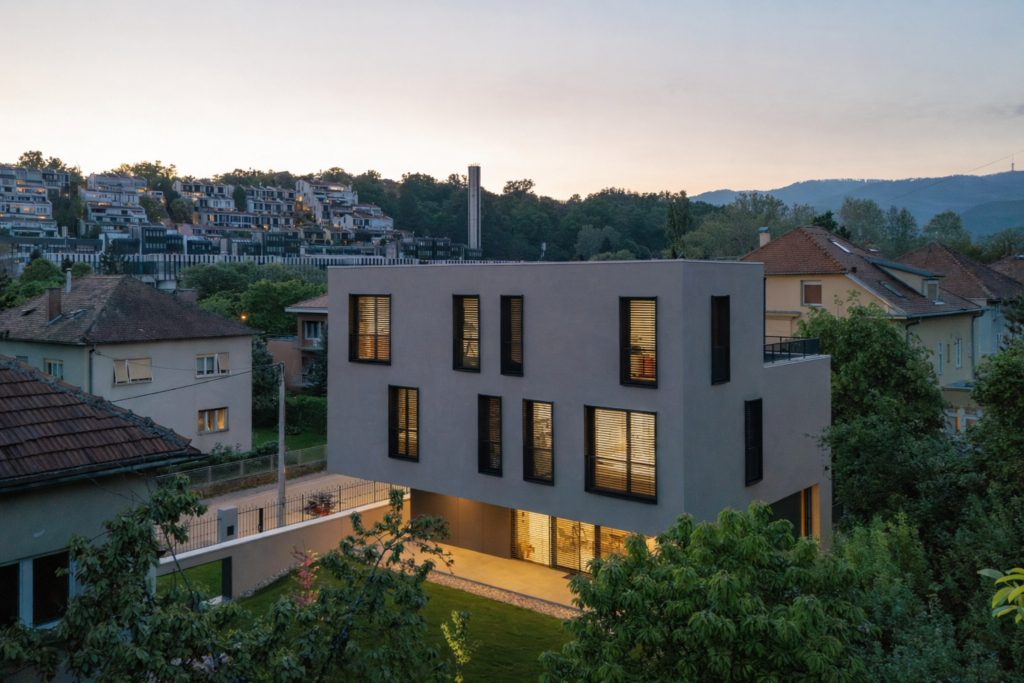
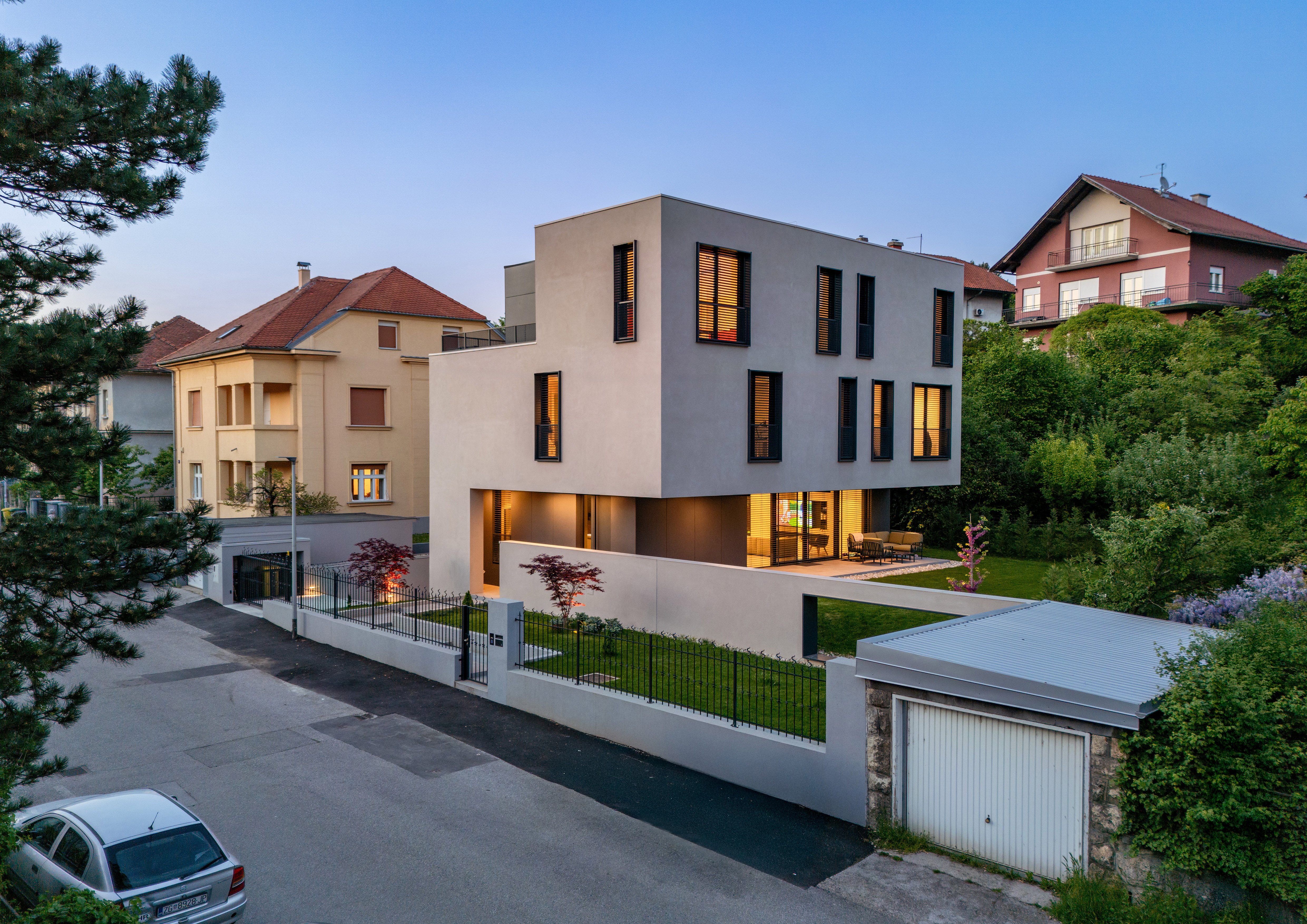
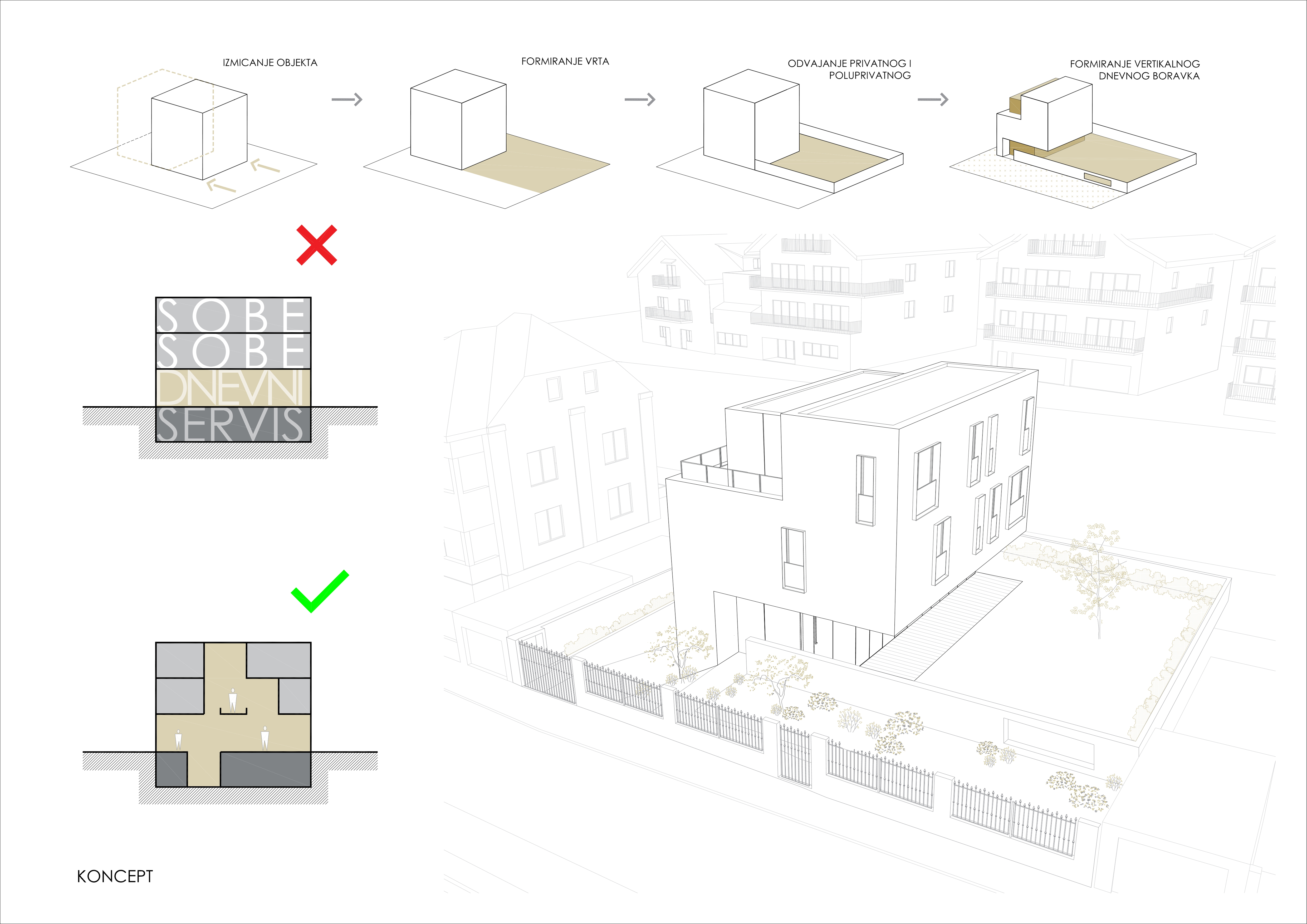
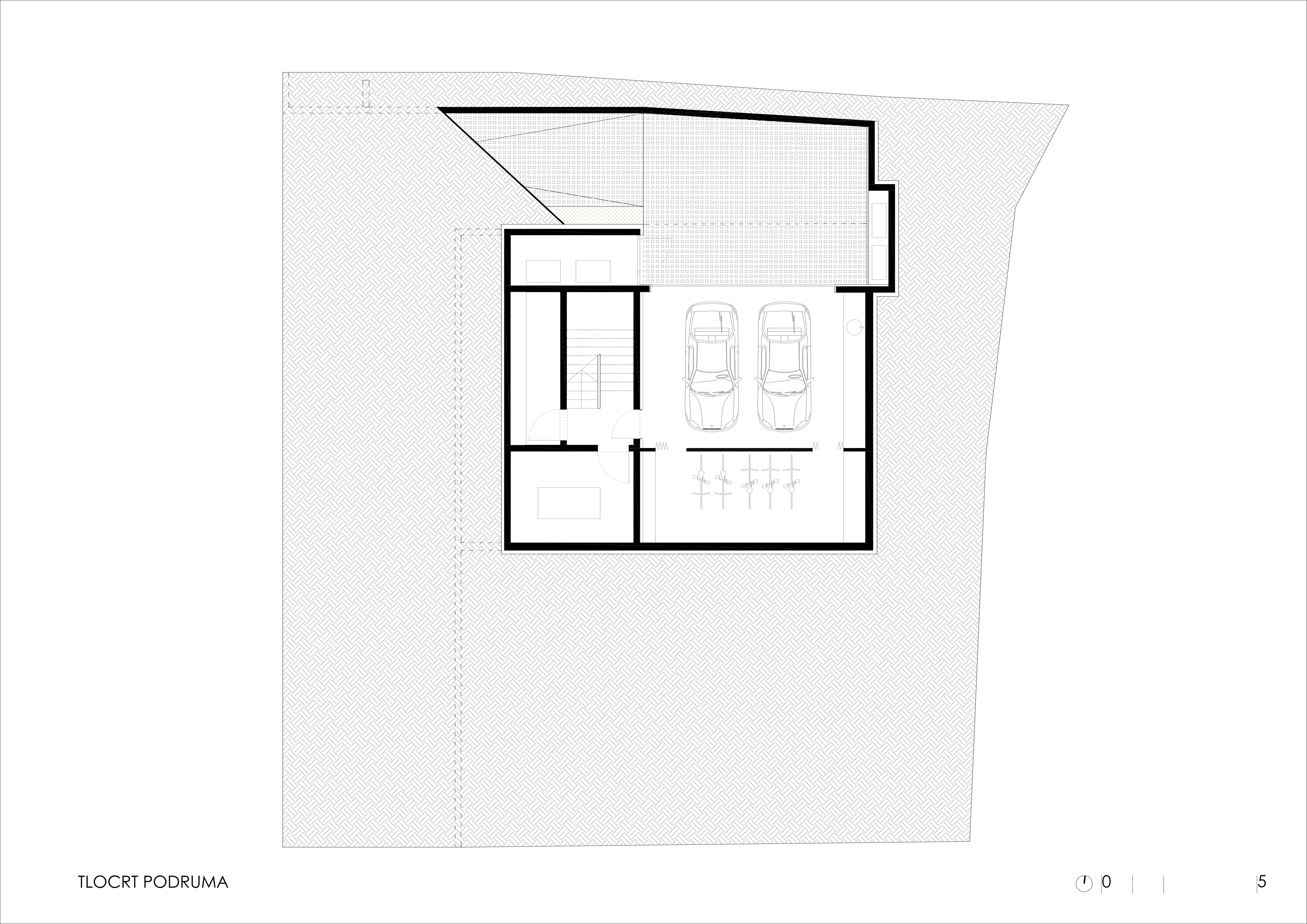
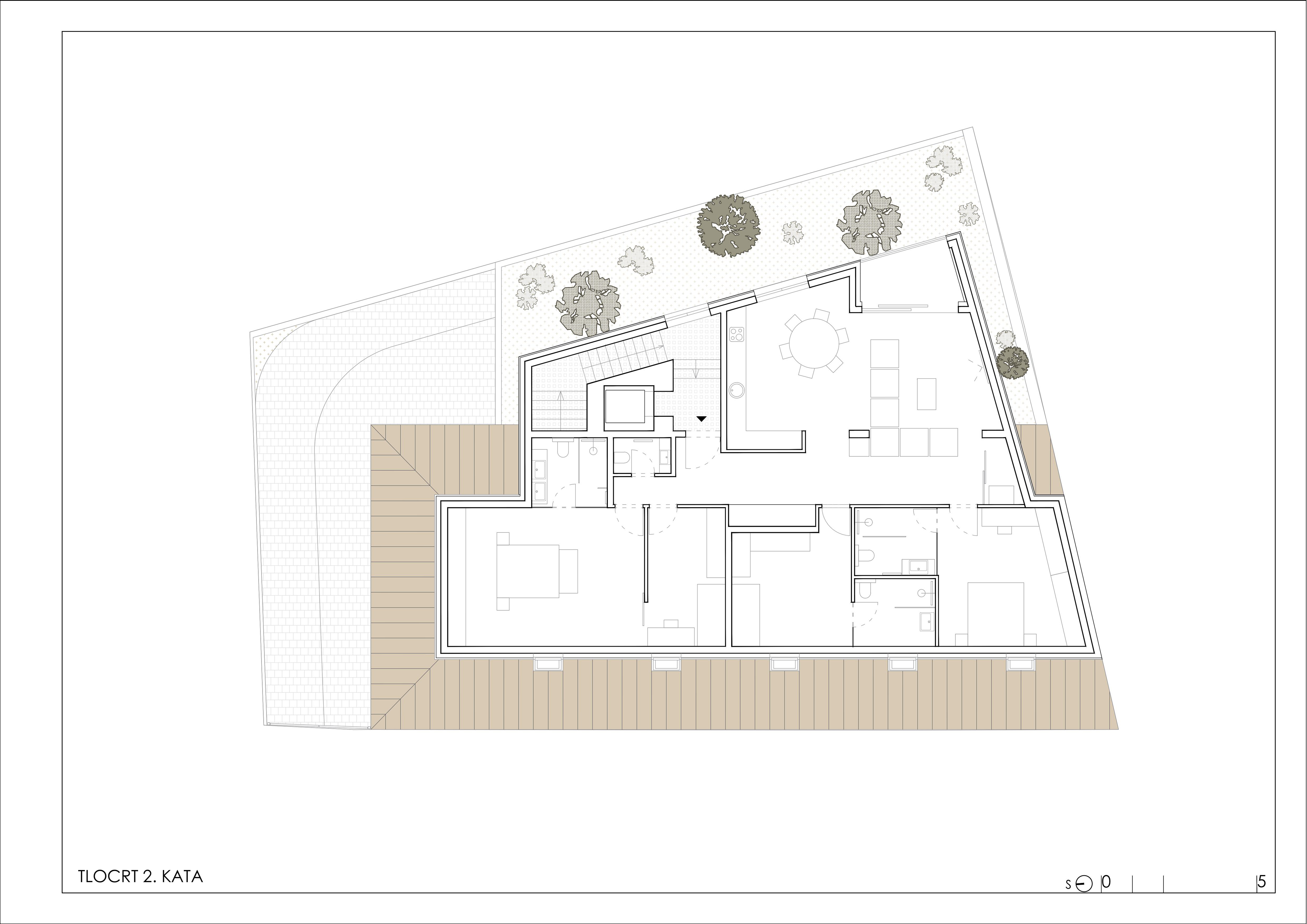
Radićevo Promenade Urban House is conceived through a dialogue with its immediate context and within a strictly defined planning and conservation framework. The volume is set back as far north as possible relative to the existing house, freeing the southern portion of the plot and forming an enclosed garden as the primary outdoor living space.

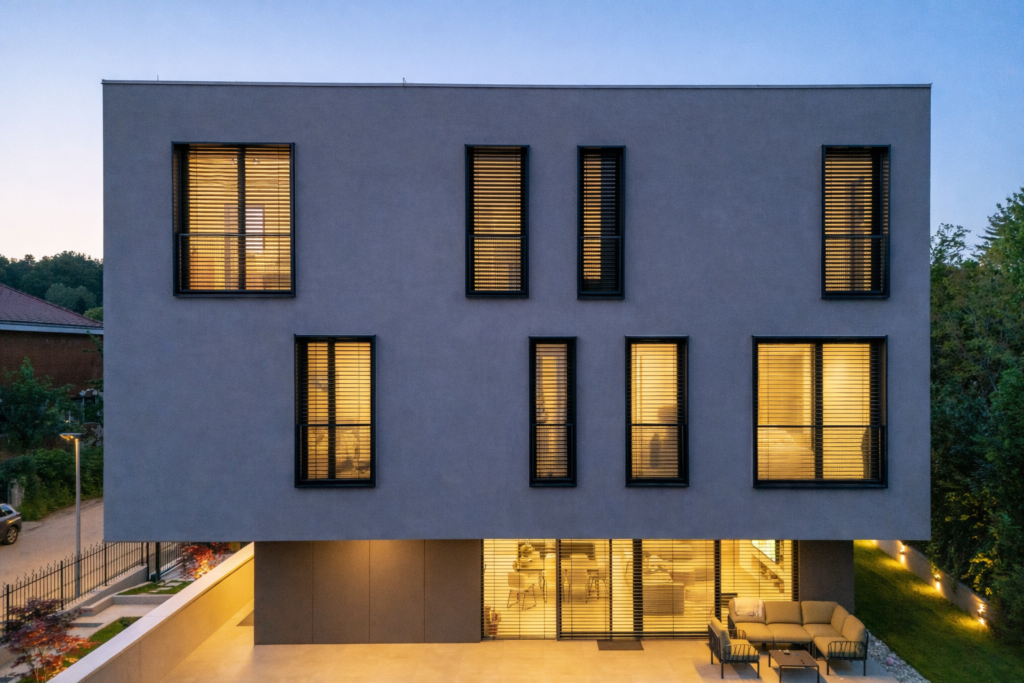
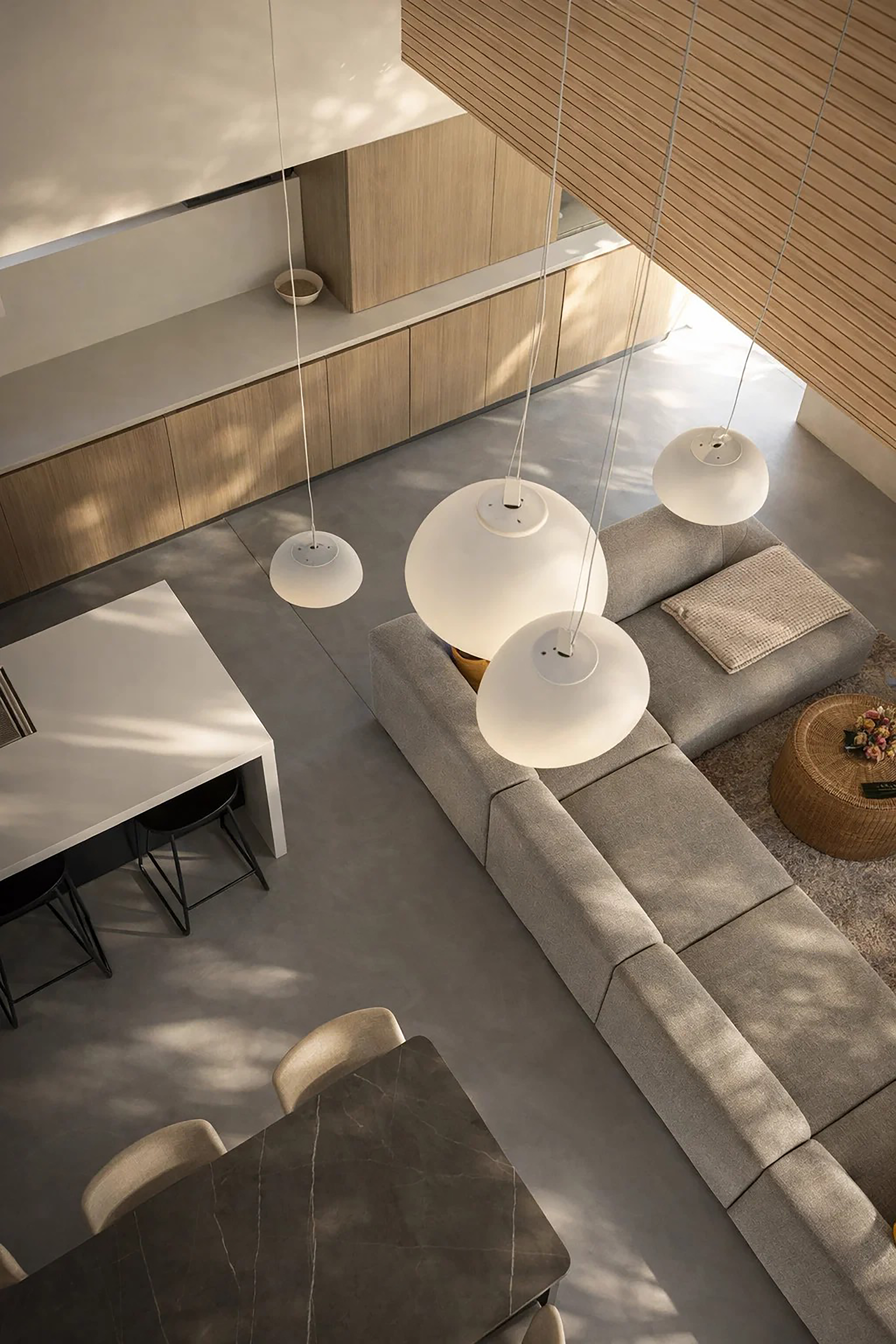
The garden acts as an extension of the triple height living area, providing optimal sunlight, privacy, and a strong spatial continuity between interior and exterior. It is enclosed by a perimeter wall that follows the logic of the surrounding fabric, clearly articulating the distinction between the private garden and the semi private forecourt. A carefully positioned opening establishes a visual and spatial connection between these two zones, reinforcing the urban character of the house and its integration into the city fabric.

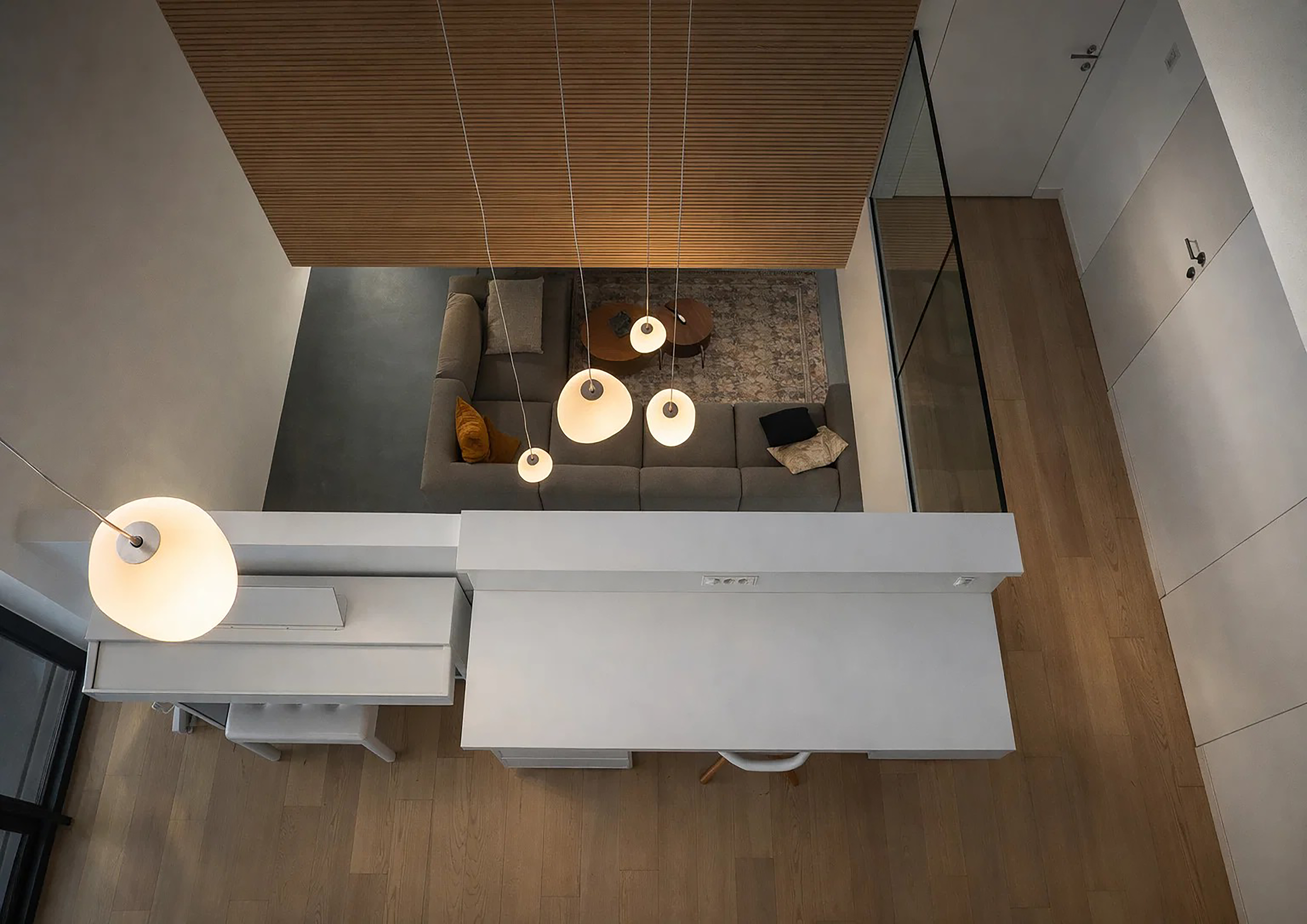
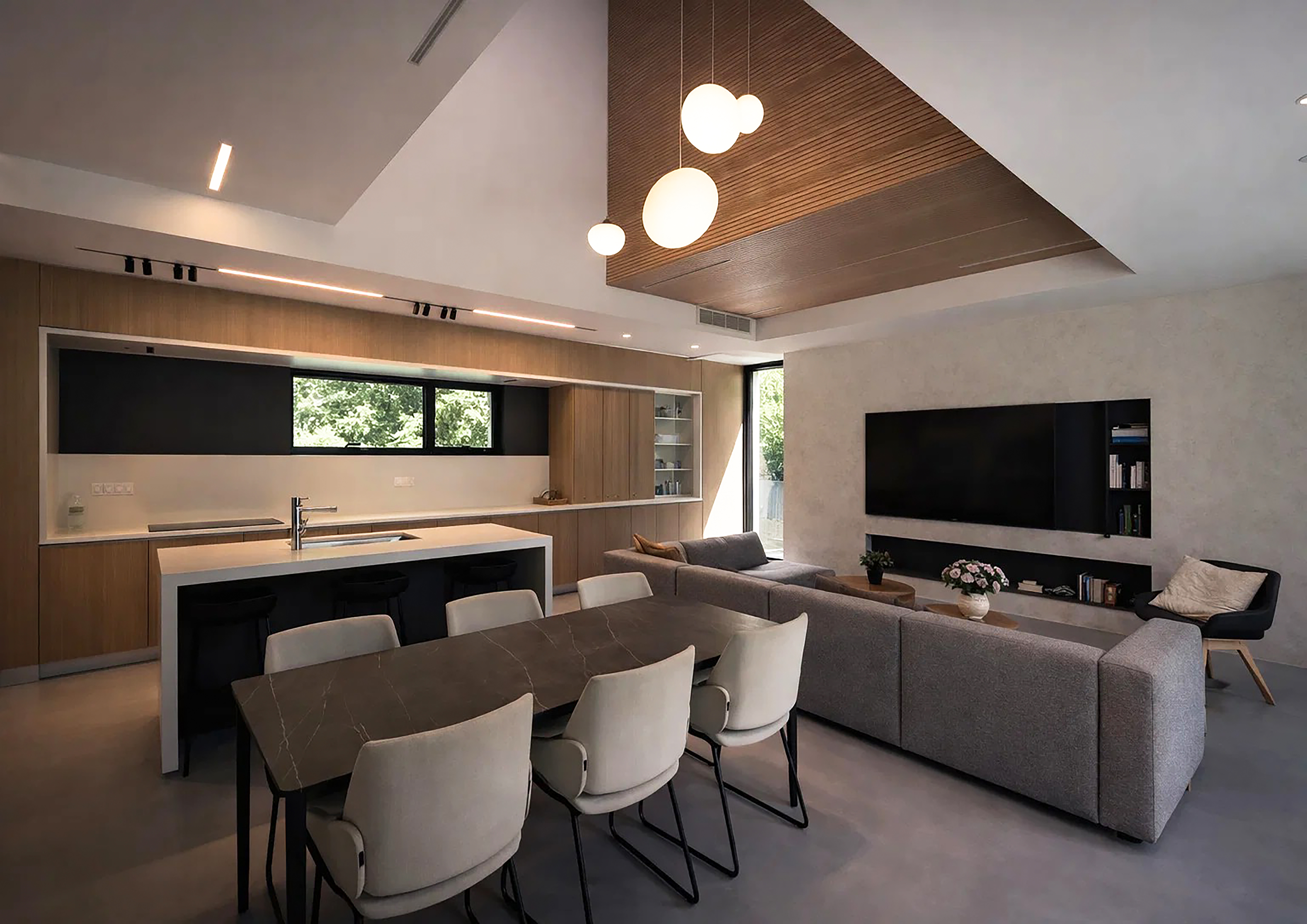
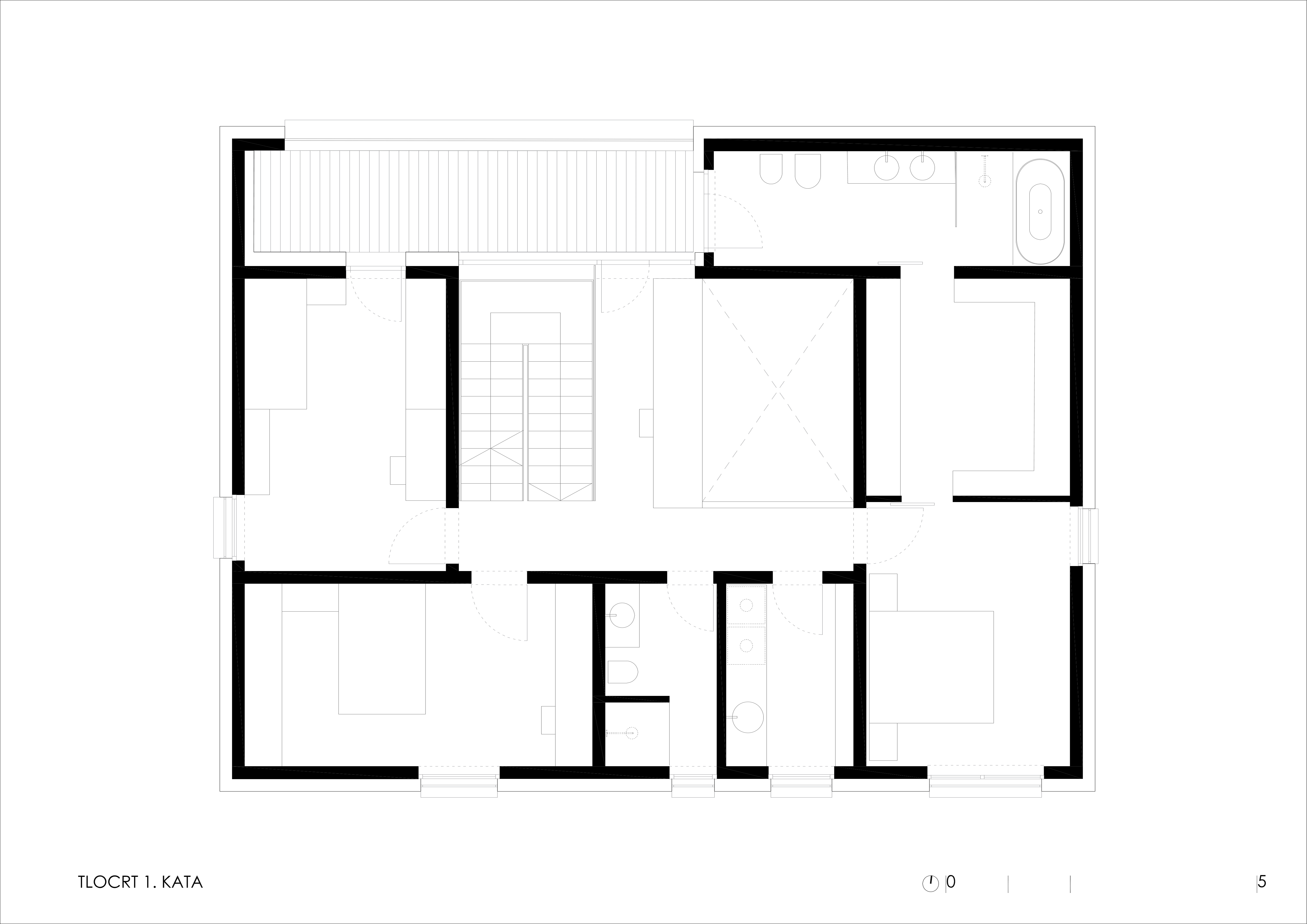
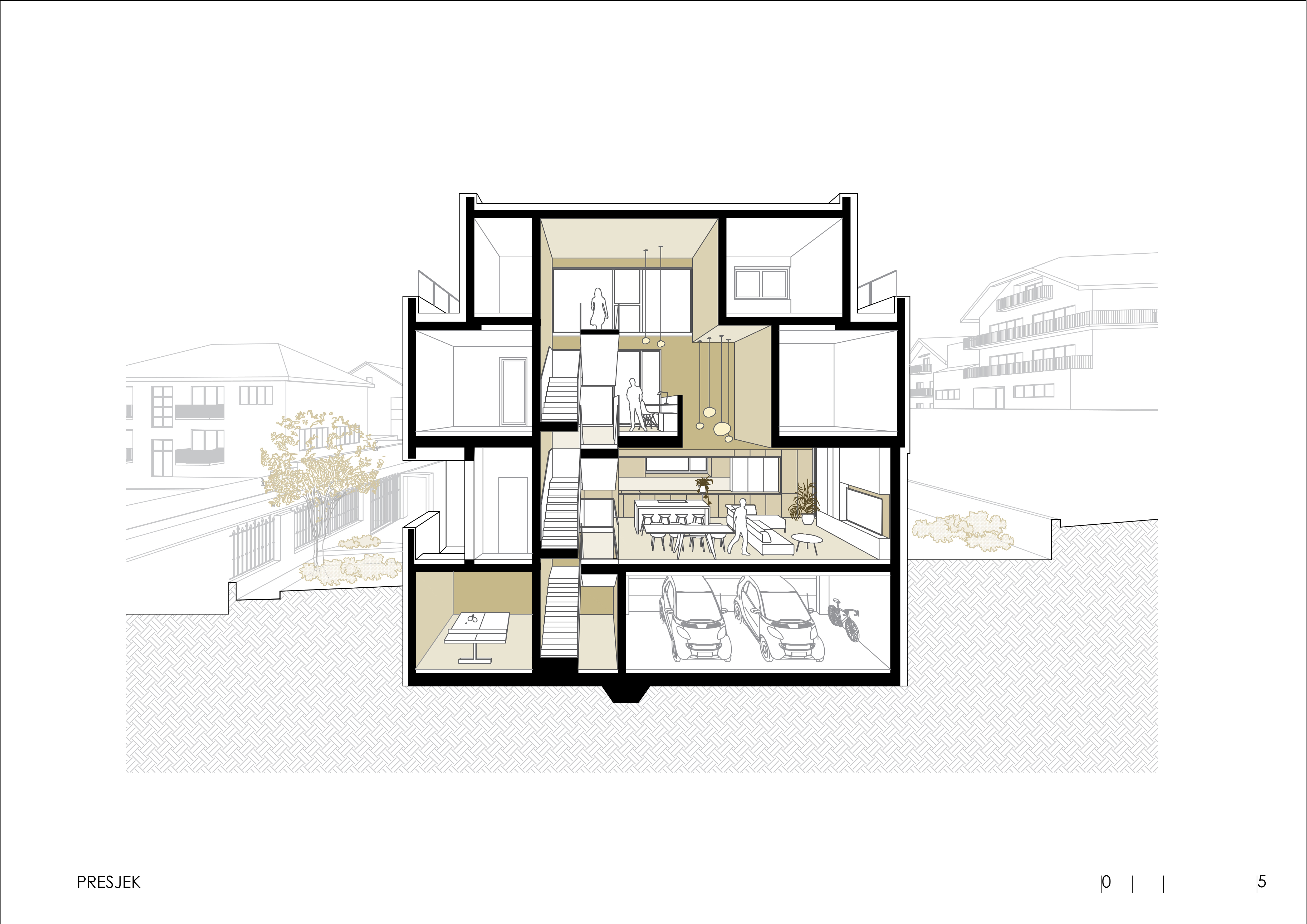
The fundamental design challenge lay in accommodating a home for a six member family within a volume constrained by regulations, balancing a generous shared living space, individual rooms for children, dedicated workspaces for the parents, and additional programmatic requirements. The tension between a compact footprint and a complex brief is resolved through vertical organization and the formation of a three level central living volume. The ground floor living room acts as the social core, while the staircase and galleries connect the levels into a continuous spatial dialogue. The basement accommodates utilitarian and social functions.

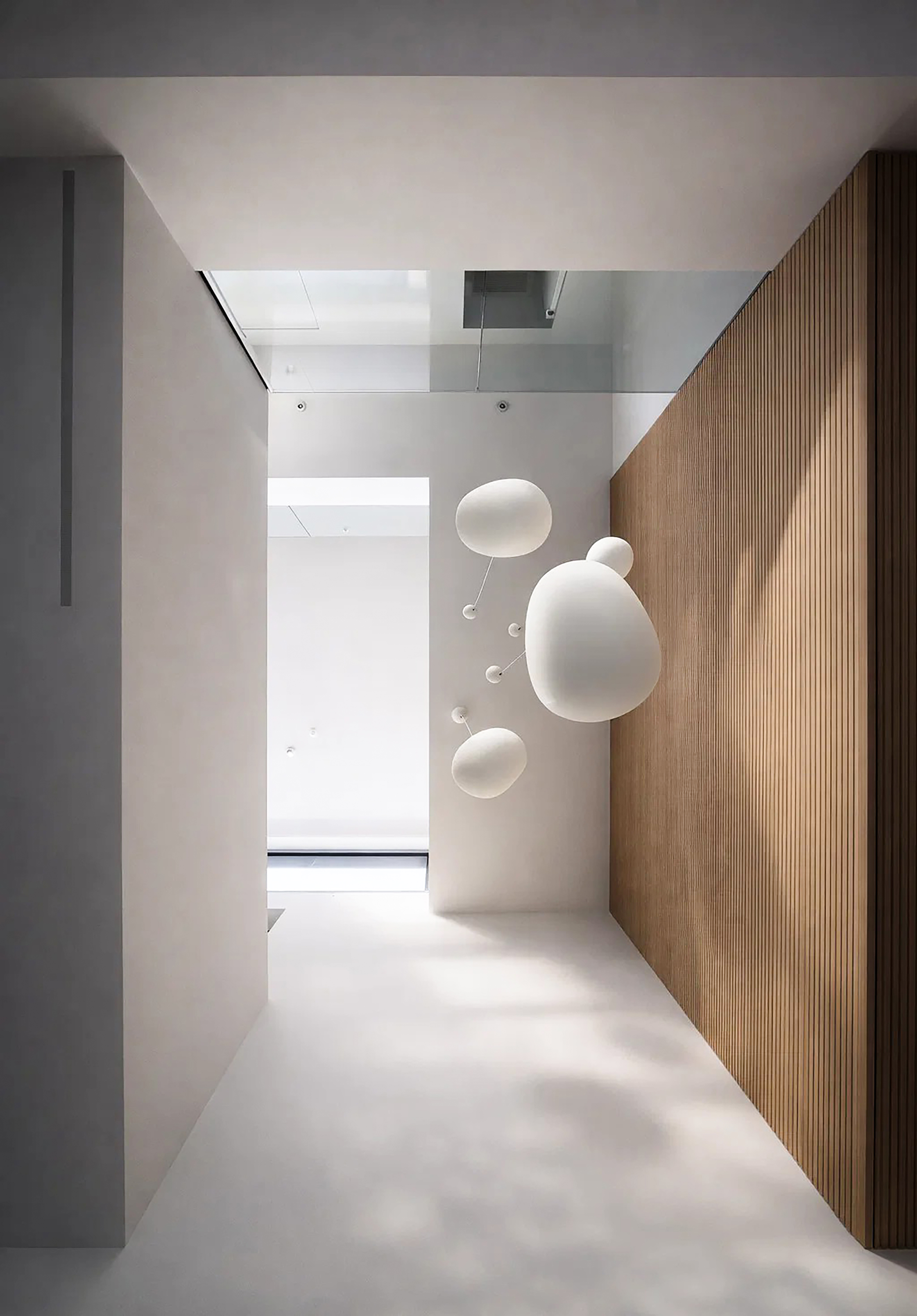
The interior is defined by the sculptural treatment of the staircase rising through a central void, clean lines, and a palette of warm materials that emphasize spatial depth and continuity. The exterior responds in a disciplined manner to the promenade context, reinterpreting the existing condition through tone and materiality while maintaining the continuity of the street frontage.

Authors:
Nenad Ravnić, Kata Marunica, Damjan Kolundžić, Filip Vidović, Frane Dumandžić
Project team:
Mirjana Krndelj, Natja Mihaldinec, Lovro Hubzin
Collaborators:
Krešimir Vučinić, Srđan Grujić, Alen Farago, Domagoj Orehovec, Ivan Gadže, Damir Borić
Photo:
INTERIOR Ante Sušić

EXTERIOR Marko Devčić

Investors:
Private
Status:
Built
Design Year:
2021 - 2023
Realisation:
2023 - 2025
Plot Area:
561 m²
Gross surface area:
391,80 m²

Nova Ves Housing

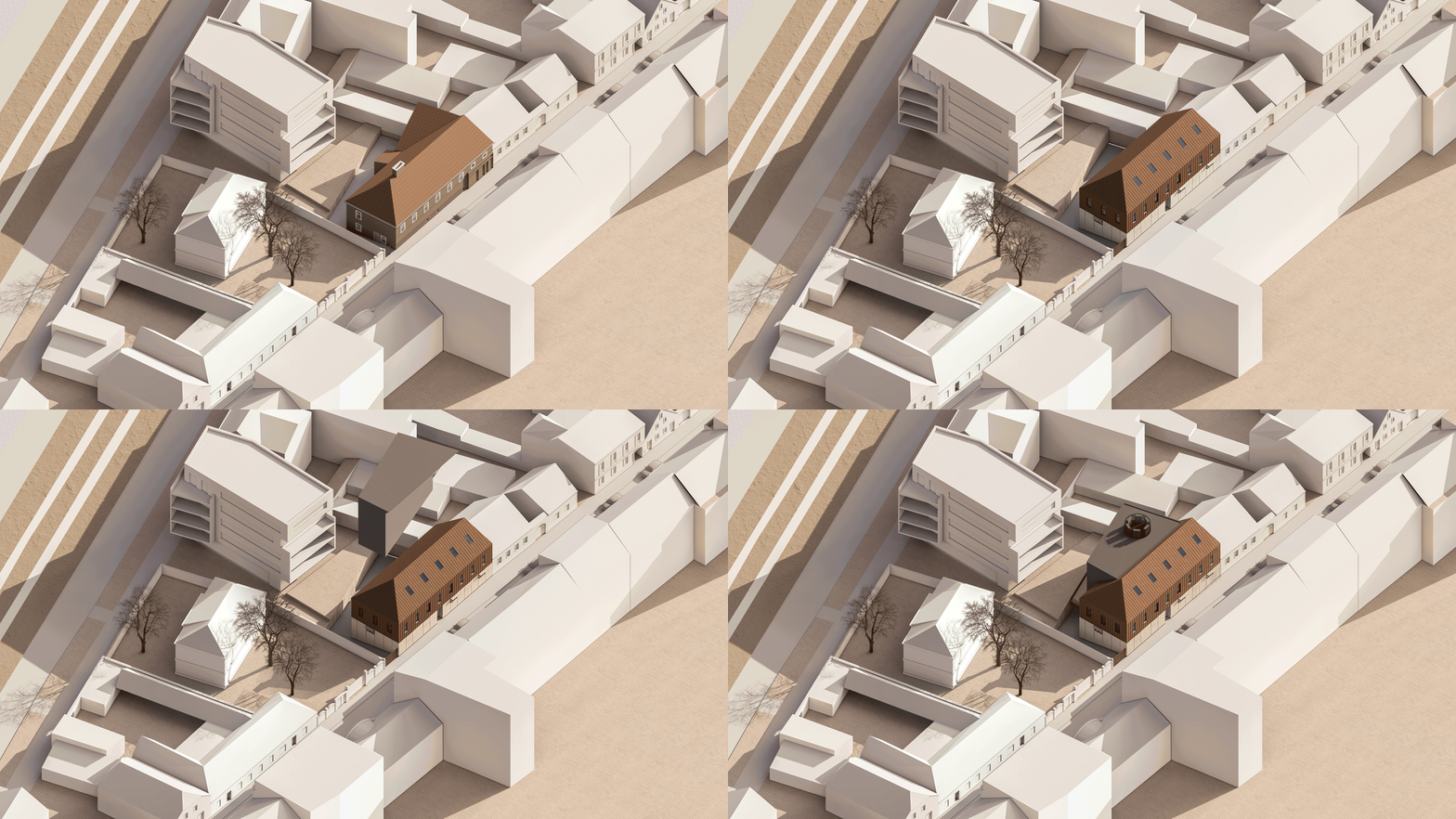
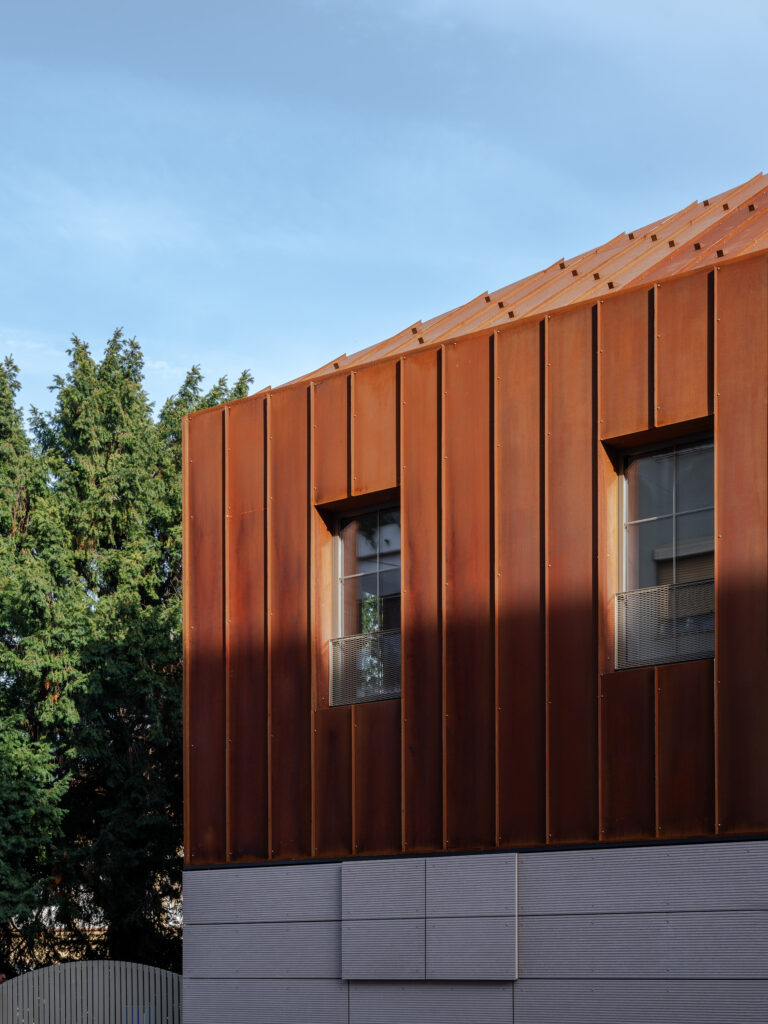
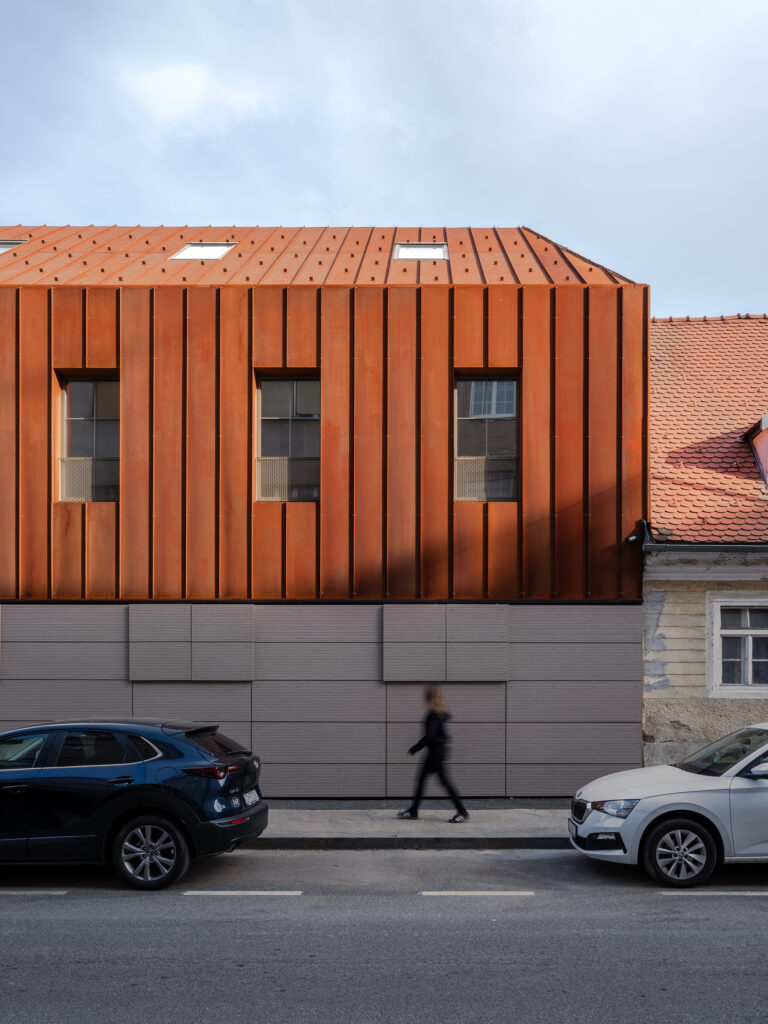
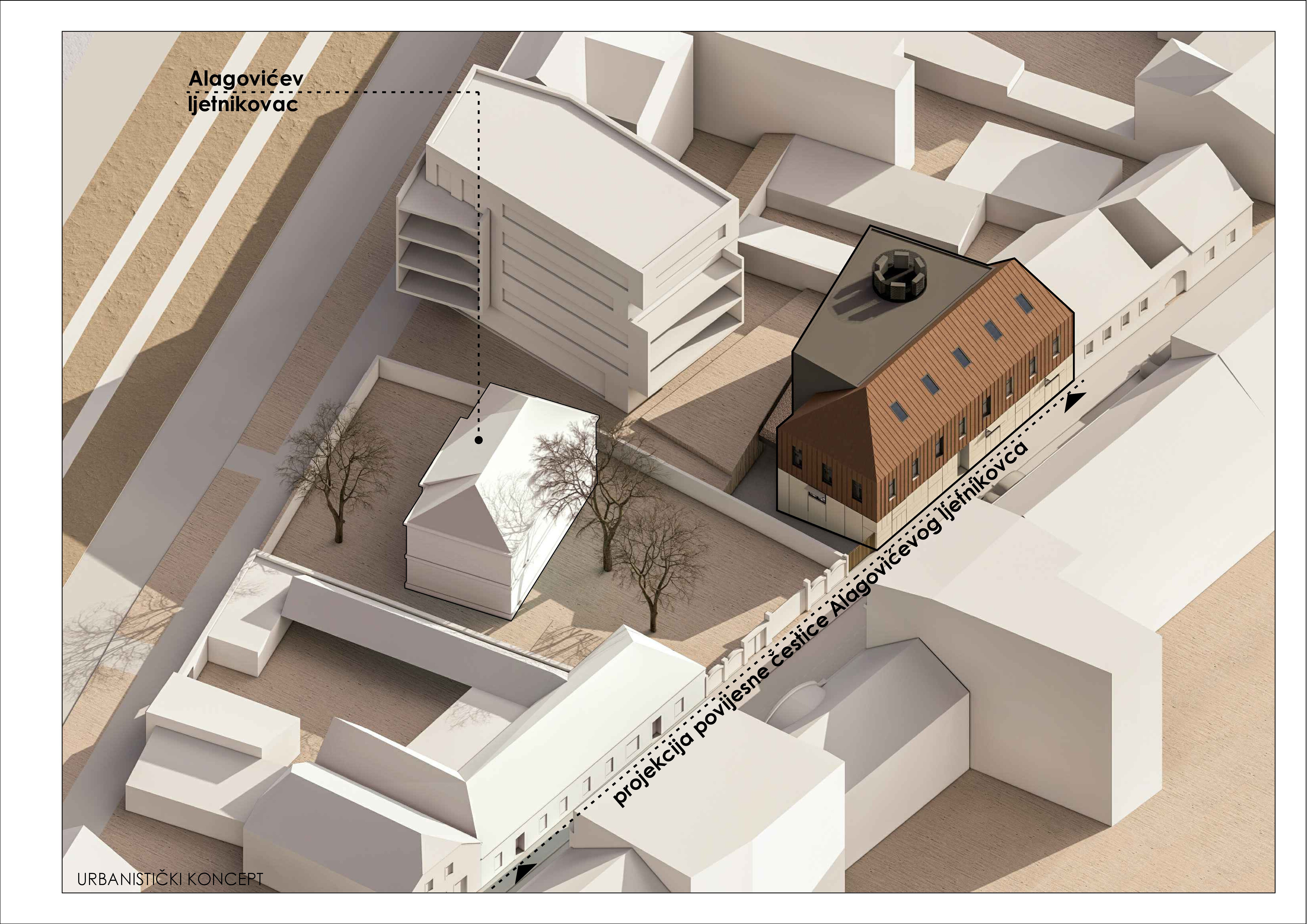
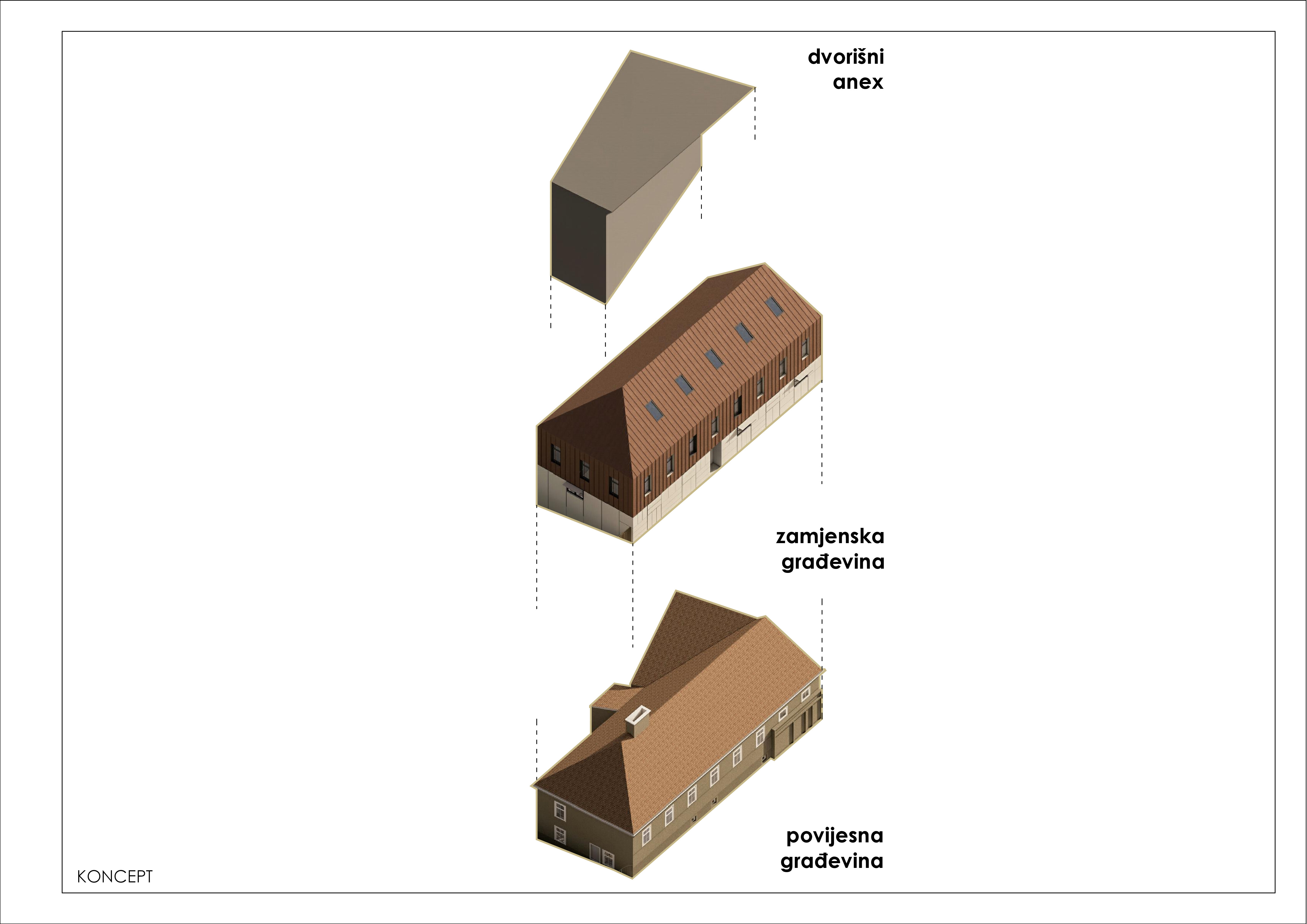
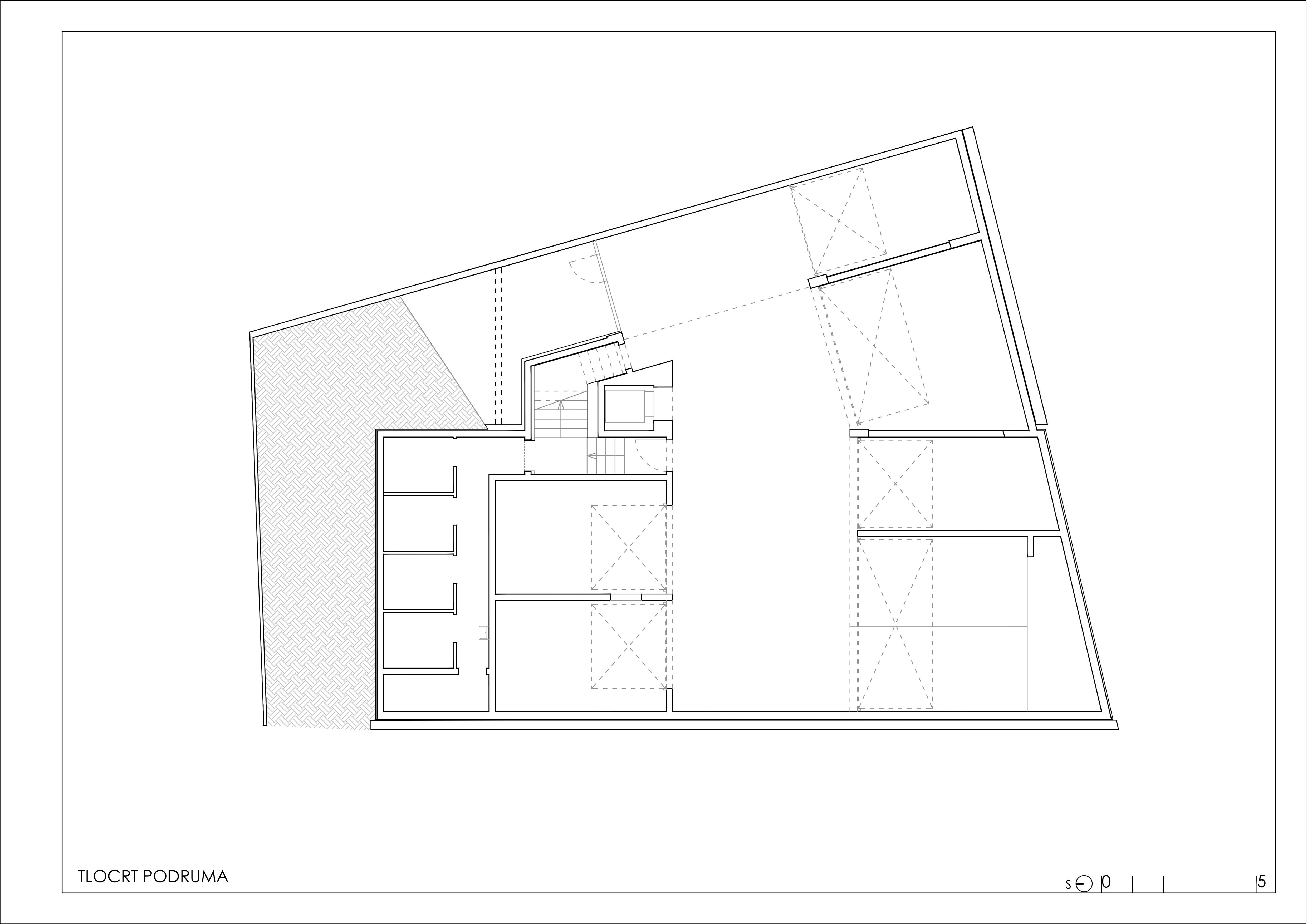
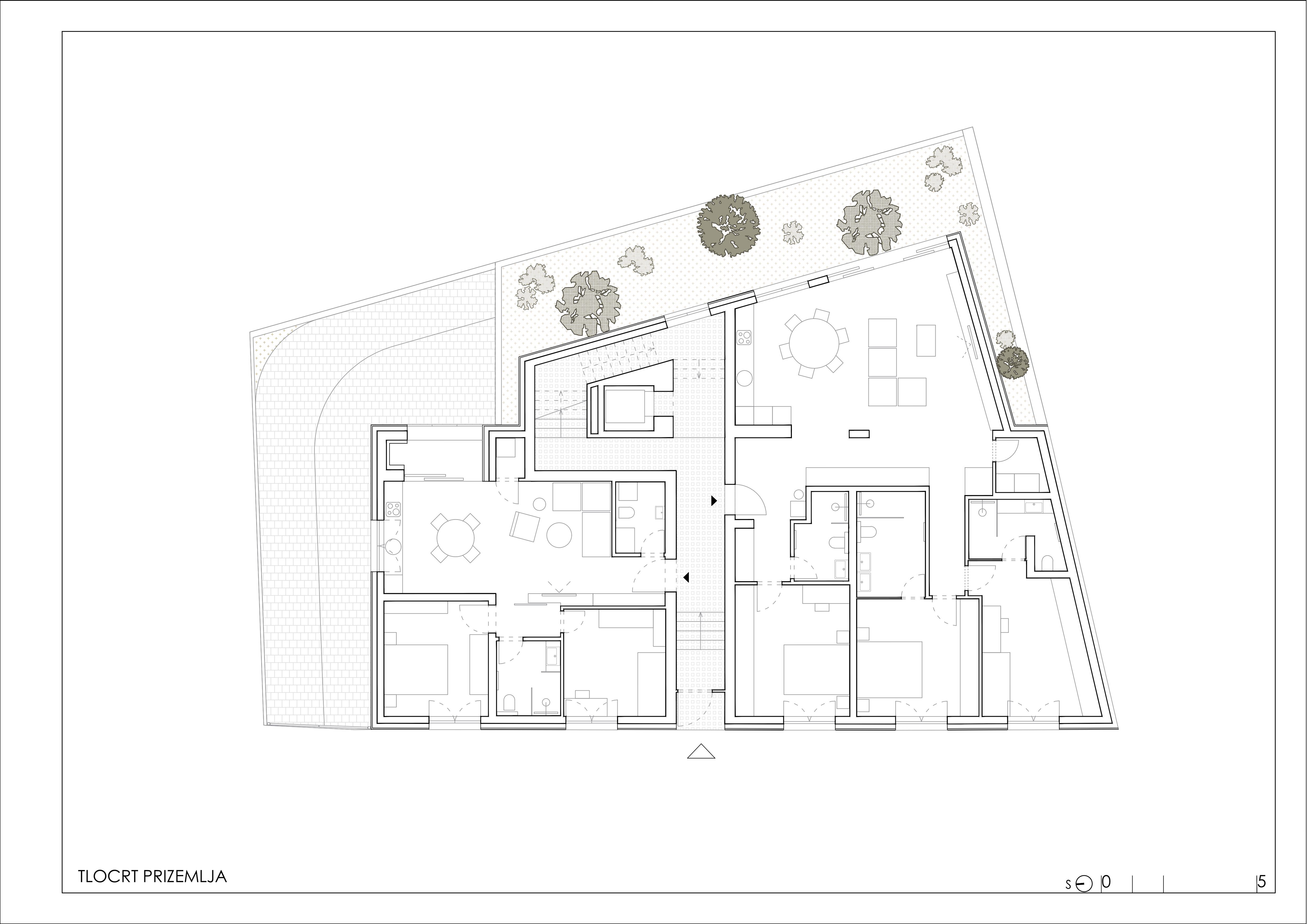
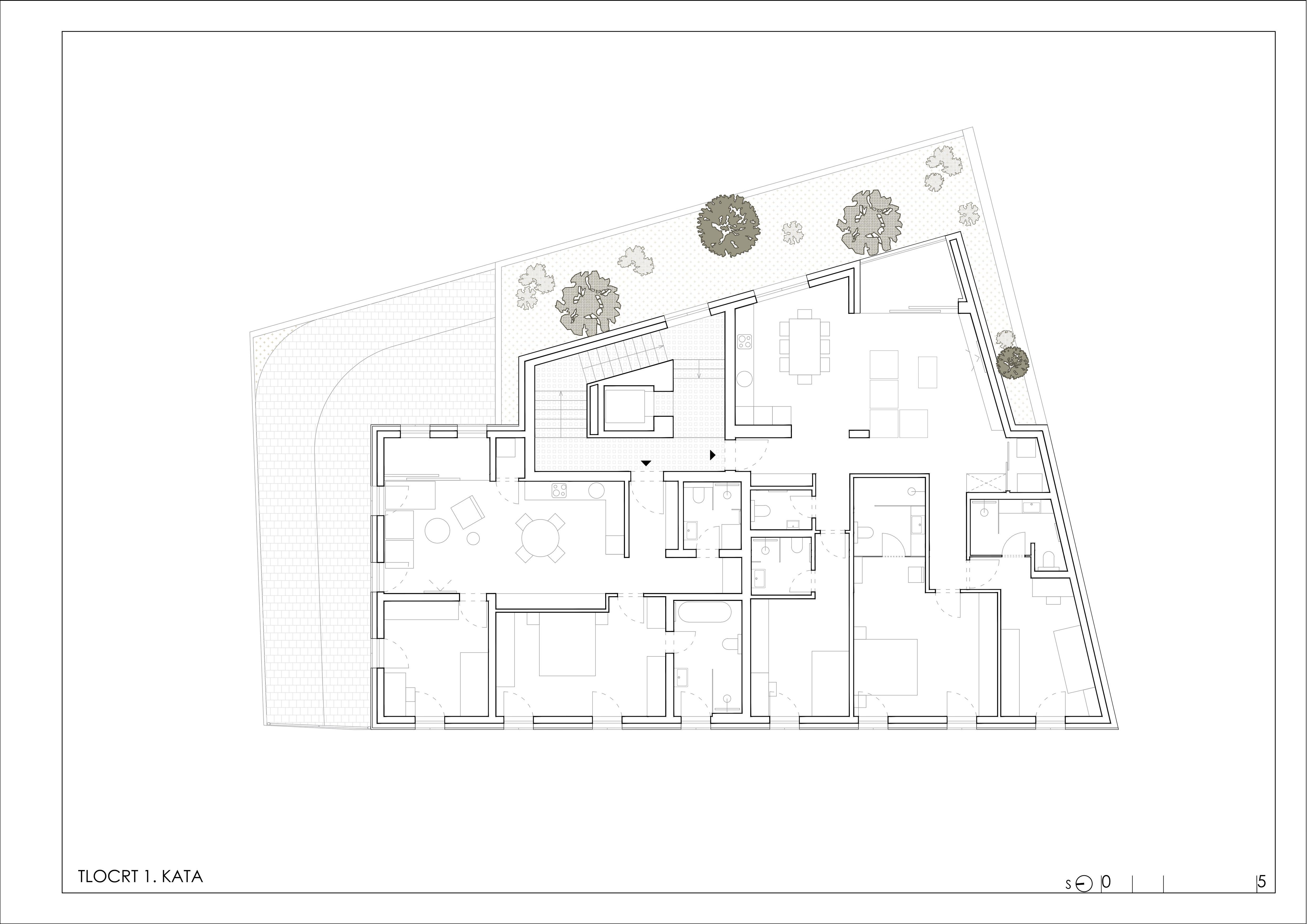
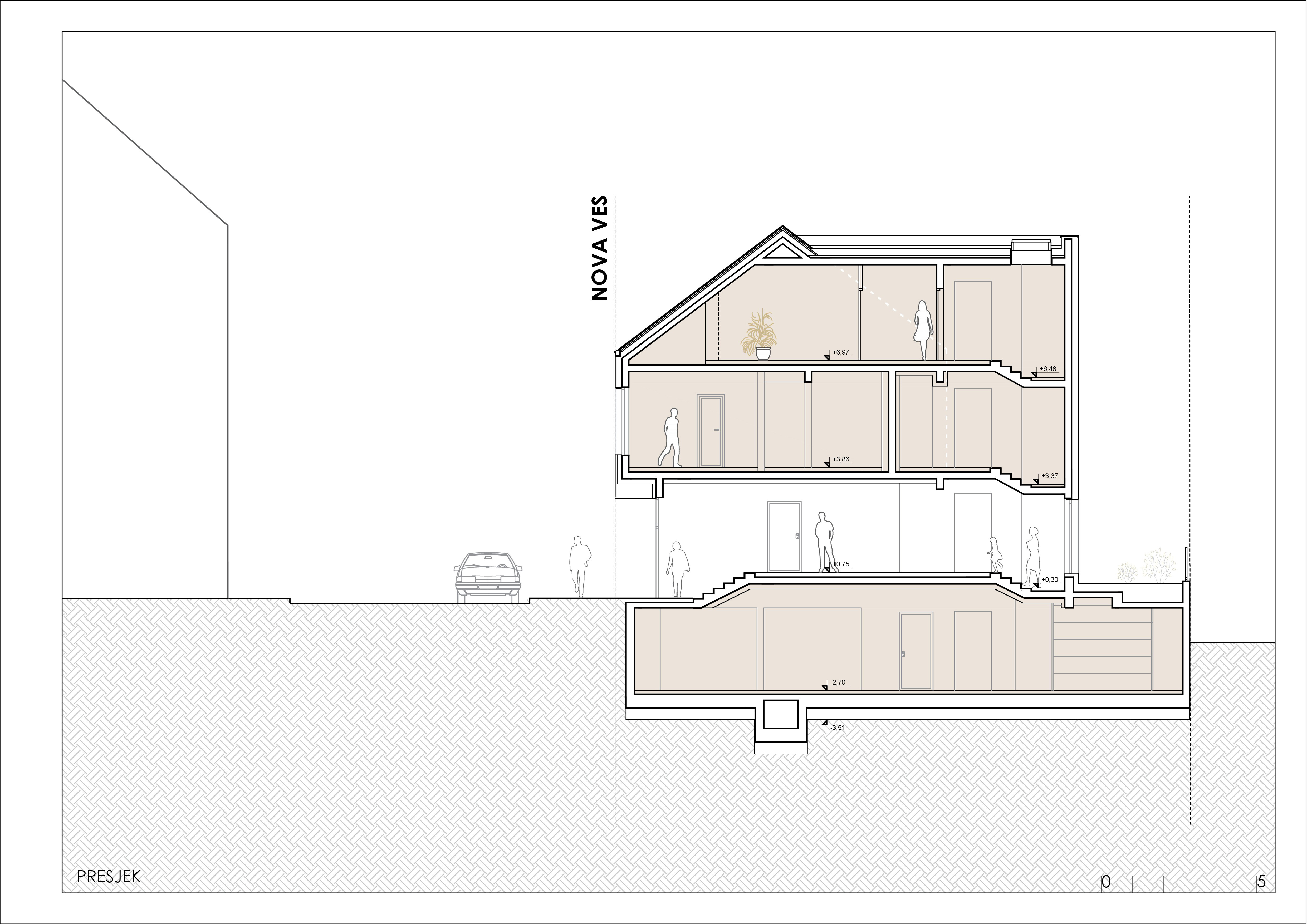
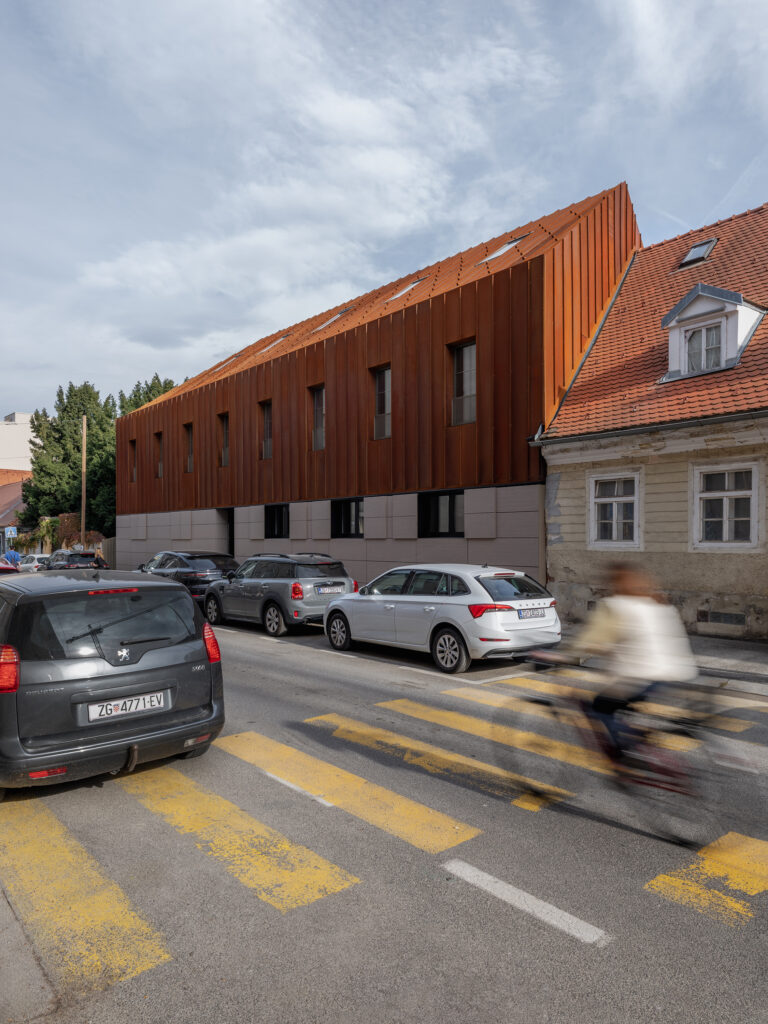
Nova Ves Housing was developed within the oldest historical layer of Nova Ves, in the immediate vicinity of the historic summer residence of Bishop Aleksandar Alagović. The historical stratification of the site called for a sensitive design approach—one that acknowledges both the visible and the “silent,” undocumented layers of the existing environment, while respecting the scale and relationship with its valuable historic neighbour.

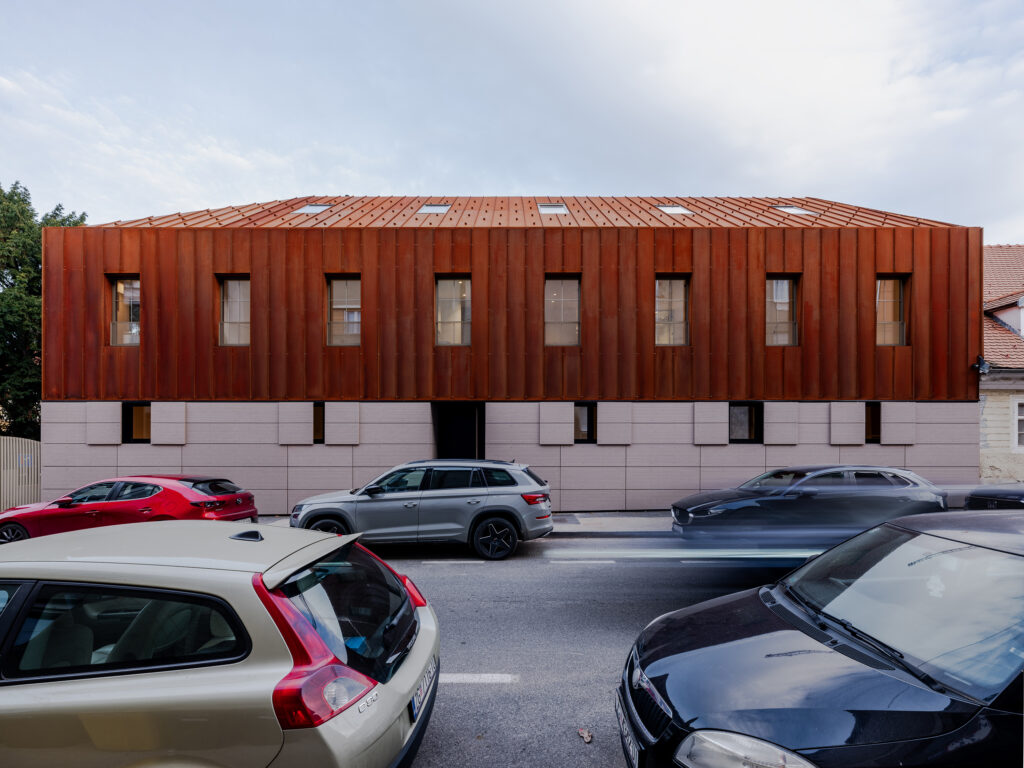
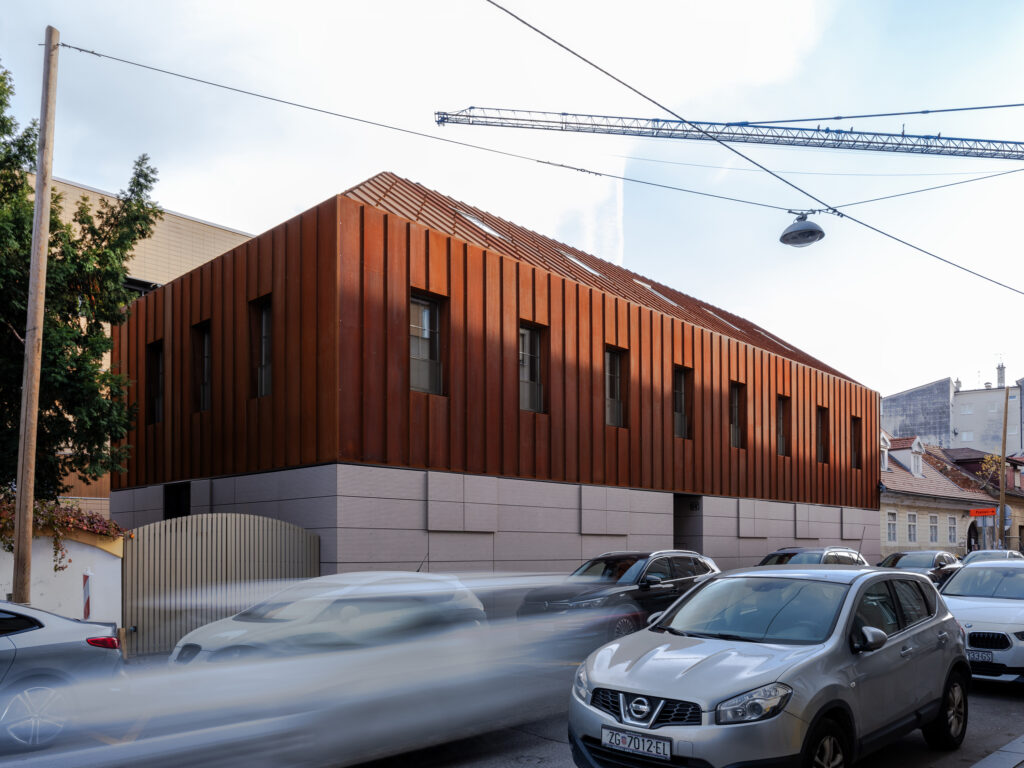
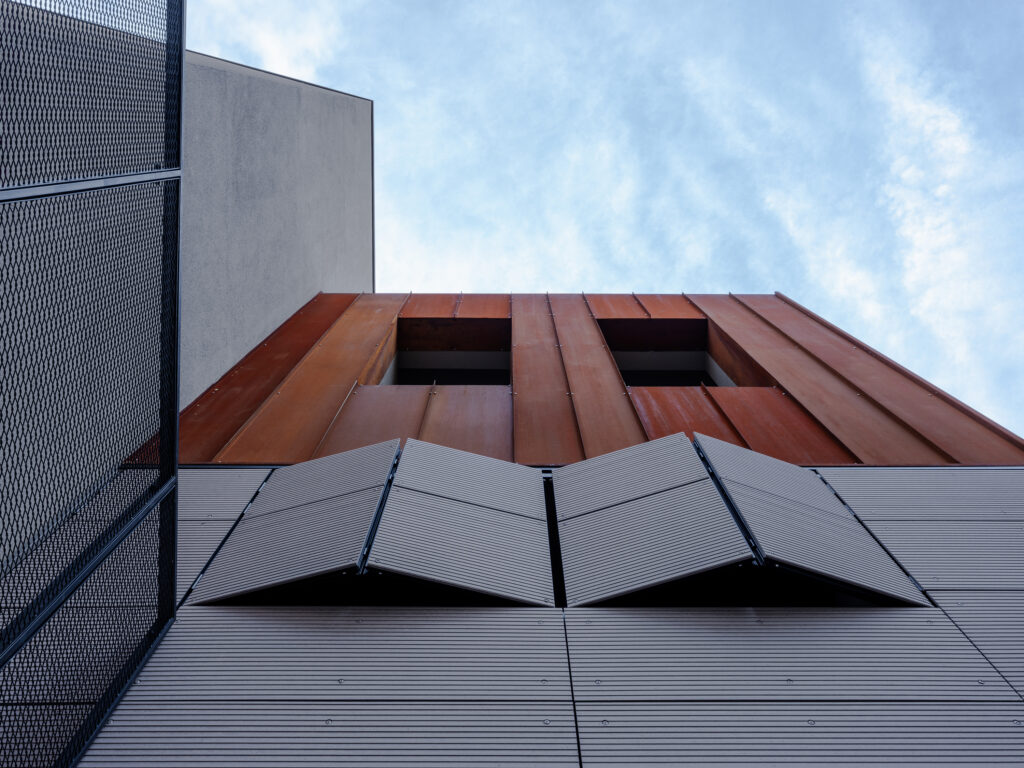
The use of corten steel in the upper zones lends the building a strong yet warm character. Its deliberate sense of “weathering” enters into a dialogue with the roofs of the surrounding historic buildings, while also resonating with the patina of nearby façades, which represent a key ambient characteristic of this part of Nova Ves. The fibre-cement cladding at the base introduces a rhythm aligned with the tones of the adjacent buildings, creating a sense of continuity from the pedestrian perspective and reinterpreting the robustness of ground floors typical of architecture from this period. The contrast of materials builds a layered façade while simultaneously respecting the context.

The house is new, but not aggressive; it is recognisable, yet it does not aspire to be a replica of something that no longer exists.

Authors:
Kata Marunica, Nenad Ravnić
Project team:
Marin Piršić, Filip Ružić, Sara Vulić
Collaborators:
Under Hill Studio d.o.o., Modular Energy d.o.o., Elektrona projektiranje d.o.o., Schindler Hrvatska d.o.o.
Photo:
Bosnic+Dorotic
Nenad Ravnić
Investors:
Kondres doo
Status:
Built
Design Year:
2017 - 2021
Realisation:
2025
Plot Area:
417 m²
Gross surface area:
827 m²
NEWS:

Heritage hotel “Kurija Mihalović”

The conceptual approach to this project is based on a balance between the past and the present, between architecture and nature, and between historical and contemporary needs. The main new addition, the swimming pool hall, is located near the Manor, conceived as a “bent earth” – a fold in the terrain that serves as a pedestal for the historical form, remaining in the background so that the Kurija remains the central spatial artifact. Along with a series of smaller interventions, a new volume is inserted into the previously unused roof space of the Manor, which protrudes through the roof plane in the form of pavilions. These offer views of the historical park and the pool roof, enhancing the new experience of the Mihalović Manor narrative.

The Mihalović Manor in Feričanci had been left in an unrenovated state for many years, exposed to the elements. The building itself was constructed in the late 18th century in a late Baroque-Classical style, and was later restored and extended in the mid-19th century. By the end of the 19th century, the Mihalović family sold the Kurija, which began to deteriorate. Over the 20th century, the building’s functions changed, including being used as a primary school and later as a residential building.

The design and programming of the future use of the Kurija, in collaboration with the investor, was a long, nearly decade-long process through which various functional possibilities were explored, always aiming for a balance between the new function and the historical heritage.

The Heritage Hotel ” Mihalović Manor” consists of only five bedrooms and a master suite but features a variety of additional spaces – salons for various events, a music room, a wellness area with a pool, and a special wine cellar where only wines from the Enosophia brand, owned by the investor, are served.

Certain functions are located within the historical building, while the underground garage, services, and wellness with a pool are placed at the rear of the Manor, beneath the grassy area of the historical park. This topographical change in the pool area signals the dynamics of the new functions.

In accordance with conservation guidelines for the restoration, the exterior of the Kurija has been restored while preserving its historical architectural elements. The entrance portals on the south and north façades have been reconstructed, and other elements have been preserved in their entirety. Inside, all modern partitions were removed on the ground floor, and the vestibule was returned to its original level. On the upper floor, all later structures were removed, and the series of salons was reestablished through the shared spaces of the day rooms and reception areas.

Along with the construction, the investor managed to acquire furniture and artwork that had been removed from the Kurija after World War II and taken to Zagreb, further enhancing the heritage value of the space.

The complexity of designing such a building is also evident in the high roof. The master suite with two bedrooms is located in this space, with openings in the roof structure forming pavilions that offer views of the park from the courtyard side. The historical wooden structure has been reinforced with an additional steel frame to support the cantilevered pavilions. Unlike the ground and first floors, which preserve the historical character, the roof space is fully modern, complete with contemporary furnishings, and is accessible by a lift directly from the underground garage, which is hidden beneath the park.

The placement of the pool building in the courtyard, relatively close to the historical structure, does not compete with the Manor, and it is connected to it by an underground passage. The green, fifth façade, or the roof of the pool building, is the most important façade, as it is the one most visible from the most representative first floor of the Manor. The green roof is elevated like a tent structure, forming a clear connection with the surroundings, focusing the view on the Manor and the park, which become an integral part of the pool hall experience.

Project team:
Nenad Ravnić, Kata Marunica, Filip Vidović, Marin Piršić, Ivana Triva, Maja Bencetić, Mirta Mesić, Frane Dumandžić, Antonio Omičević, Nikica Pavlović, Goran Rukavina, Ante Sušić, Karla Tavić
Collaborators:
Radionica statike d.o.o., Termoprojekting d.o.o., Geneza d.o.o., Inspekting d.o.o., Schindler Hrvatska d.o.o., Apin projekt d.o.o., Krešo Geo d.o.o., Grid d.o.o., Naravno d.o.o., Tihomir Jakob (Ingeniero Mecánico Certificado), Denis Paleka (Ingeniero Mecánico Certificado), BAZ Projekt d.o.o., Nexe d.d., PBG d.o.o., Fusio d.o.o., Boris Gerenčević, Šulentić-Lenart d.o.o., Premur d.o.o., Tablinum d.o.o.
Photo:
Marko Banić, reroot
Investors:
Nexe dd
Status:
Built
Design Year:
2009 - 2019
Realisation:
2020 - 2024
Plot Area:
6,332 m²
Gross surface area:
2,554 m²
NEWS:

“MAJ Townhouses”


Maj townhouses were created as a kind of experiment on the subject of housing. Within the urban unconsolidated perimeter of the city of Poreč, the project brief initially envisioned a standard residential building with commercial apartments. A residential building is characterized as a row of ten separate houses with their own gardens and atriums, rethinking the environment in which various typologies such as family homes, vacation homes, and residential buildings mix. In this way, one building becomes a new neighborhood in itself, where residents have access to their own garden or atrium, which contributes to the feeling of personal space and enables outdoor activities within a private environment.

In addition to typology, special attention was paid to color in order to clearly communicate the number of residential units to the outside. The tones are a paraphrase of Istrian plasters with the idea of ​​quality “aging” of the facade in the Istrian sun and change in intensity over the years.

The residential units themselves have a compact floor plan, on the ground floor there are living spaces with connections to the garden/atrium, while the bedrooms are located on the first floor.

Project team:
Kata Marunica, Ana Mustapić, Nenad Ravnić, Filip Vidović, Marin Piršić, Goran Rukavina
Collaborators:
Ured ovlaštenog inženjera građevinarstva Damir Karabašić, Fabris inženjering d.o.o., E.B. PROJEKT d.o.o.
Photo:
Jan Stojković, Nenad Ravnić, Kata Marunica
DRONE Photo:
Filip Ružić
Investors:
Napa Estate d.o.o.
Status:
Built
Design Year:
2021 - 2022
Realisation:
2024
Plot Area:
1400 m2
Floor Area:
420 m2
Gross surface area:
910 m2

[

Central squares in Koprivnica

EXISTING CONDITION

The area of intervention can be segmented into three zones that form logical spatial units: Ban Jelačić square : a wide street with trees that occasionally hosts seasonal events; a square in front of the market: generator of the largest daily pedestrian and bicycle traffic; and the main city square Zrinski: an apparently oversized square bounded on one side by the green facade of city park, and on the other side by the facade of an unfinished block of various contents and the city hall to the east and the old “Podravka” building in the west. Each of the mentioned spaces has a specific potential that distinguishes it from others, and the possibility of joining the system of public spaces in the center of Koprivnica.

The main square of Zrinski, seen from the air, acts as an intersection of roads and pedestrian wpaths stretched between streets and smaller squares in the east and west. This spatial tension has made the main square of Koprivnica a transit place : a space defined more by flow and movement, and less by lingering and everyday activities. With intuitive lines of movement, cyclists bypass the vast empty space “cutting” the square diagonally in order to get from one end to the other as quickly as possible.

CONCEPT

Accepting the flow as an inevitability in the functioning of new city square, and bicycle paths as a kind of coordinate system, smaller zones are formed between the mentioned paths and the perimeter of the square.Zrinski square is like a collage of activities defined by micro-locational specifics. A “tapestry” of smaller squares structured around the solid axes of bicycle paths in the form of an “X” has been laid on ground. Each zone corresponds directly with the purpose of the surrounding context or brings its own new amenity. By using different urban equipment, light/shadow and different paving, we form an urban collage of possible smaller zones created with regard to the context and habits of citizens of Koprivnica. Neighboring squares become so-called “green vestibules”, giving Zrinski Square clear visual borders.

Project team
Maja Bencetić, Frane Dumandžić, Kata Marunica, Nenad Ravnić, Andrea Šandrk, Roko Šarić, Karla Tavić, Filip Vidović
Photos
Pedestrian photos: bosnić+dorotić

Drone photos: Zoran Bakić;
Filip Ružić

Investors
City of Koprivnica
Surface
15000 m2
Status
Built
CHRONOLOGY:
2019 - 2023
COLLABORATORS
Aquachem d.o.o.; CO-art d.o.o.; Grid d.o.o.; Lipapromet d.o.o.
AWARDS:
- Balkan architectural biennale 2023 – Recognition in Urbanism - Paysage Topscape - 3rd prize in STREET LANDSCAPE & SLOW LANDSCAPE category - Jutarnji list - posebno priznanje - Jury Grand Prize in the Space Category at the Designverse Awards 2024-2025 - Fourteenth session Idea-Tops Award - Urban Landscape Design

PROJECT

The Zrinski Square is divided into twelve smaller zones. Each of these zones is adapted to the nearby building or micro ambience. For example: in front of the gallery zhere is an „art zone“ with pedestals for occasional exhibitions and circles for drawing on the florr. Under the maple trees is a “pop-up zone“ for summer events. In front of the bars and restaurants are „coffee zones“for parasols and tables. The square is mostly made of concrete pavers of different dimensions, layout and processing schemes. The color of the pavers themselves is the result of a careful analysis of the facades of the surrounding buildings, historical heritage and the Podravina ambience itself. Paths with reddish paving stones, which are a reference to old brick roads, are especially emphasized. Multifunctional zones for occasional gatherings are ocher-yellow ephasizing their symboling importance, while other zones are in shades of gray. In the middle, there are mosaics – an interpretation of the famous Podravina embroidery. The bicycle lane “X” that crosses the square is made of rough-hewn concrete to emphasize the change in material. The new fountain, identical in shape to the old flower garden – rundele, is now a multipurpose fountain paved with gray flamato sandstone. The fountain itself is lowered 2 cm in relation to the square, and can form a water mirror that reflects the park and the old Town Hall, while in the summer it becomes water playground for the youngest residents of Koprivnica. The urban equipment of the square adapts to the environment and encourages different activities. It includes wooden benches next to the park, benches/pedestals on the “art-square”, benches-bike racks at the entrance areas of the square and concrete circular benches around the existing tall trees towards the Park. The area in front of the library and cinema is dominated by a solar tree equipped with Wi-Fi, power outlets and a screen displaying meteorological data. Sculptures, such as the existing but also the new monument to cyclists, have been placed on the oposide sides of the Zrinski square. Horticulturar species are mostly similar to those found on site. Ban Jelačić square and the Market square are additionally embodied with rows of maple trees Acer globosum. Existing tree line on Zrinski square is added with maples and soforas with spruce bushes underneath. Red japanese maples are placed in the “art zone” inside circular benches/planters together with the Ophiopogon plant.
Gordan Lederer Memorial

Broken lens on the edge of hillside Čukur, over valley of the river Una. Lens is cracked and burrowed into the grass. The access path is directed towards the monument and stops 10 meters in front of it. Leaving the monument, the lens, untouched and surrounded by emptiness. Crossing the meadow in front of the monument is to be left to the decision of the visitor; whether to stay at the end of the path, look at  situation and go back the same way or to walk on grass towards the goal; the monument and look through the lens Gordan Lederer Una valley.

The lens is broken, mosaic of diffrent images of the Una river valley is recognized in the glass fragments, framed just and only by the coincidence of  glass breakage. Meadows clean space in front of the lens is maneuvering space, the space of locating ideal angle. View glides over the glass and watchs the scenes in the rubble, the visitor moves through the valley of  lost perspective lens Gordan Lederer.

From the valley, monument dematerialize itself and becomes just a flash.

Project team:
NFO + Petar Barišić
Photo:
Bosnić + Dorotić; Cropix
Investors:
HRT
Status:
Built
Year:
2015
award link:
2019 East Centric Arhitext Awards Contest - Finalist for Broken Landscape Gordan Lederer

AC CampingIN Stella Maris

Umag Stella

Stella Maris Camping is located in a thick pine forest in Umag, costal town in Istria, Croatia. The client’s task was to enrich the camp’s offer with a new swimming pool with accompanying amenities, and to integrate it with a new reception for the camp. The project was created in co-operation with the civil engineering office IF Projekt d.o.o. from Rovinj, which was in charge of the arrangement of the whole camp and civil engineering.

The location – nature and the pine forest was the basis for the concept of the complex. Sun decks and swimming pools are carved into the gently sloping terrain, while indoor facilities exploit the existing height difference and are located under the green roofs that branch over the sun deck.

There is no straight line separating the complex from the rest of the camp – instead it is integrated with its surroundings. This approach emphasized the concept of the entire camp – maximum preservation of nature and morphology of the terrain.

The complex consists of a large swimming pool, a children’s pool and a baby pool. In addition to the pools, there is a reception with offices, and an outdoor bar and restaurant. In this way, the swimming pool is not just an isolated camping segment – it is also the first vista when entering the camp.

Project team:
Damjan Kolundžić, Kata Marunica, Dijana Pavić, Nenad Ravnić

Konstrukcija: I.F. projekt

Photo:
Marko Mihaljević
Investors:
Plava laguna d.d.
Building area
6 500 m2
Status:
Built
Year:
2019
award link:
2019 Stella Maris - Nomination for the annual awards of the Croatian Chamber of Architects
stella maris
stella maris
stella maris
stella maris
stella maris
stella maris
stella maris

Miramare square

The location of the Miramare square is specific because it includes a part of the former Art Nouveau park, the square in front of the newly opened hotel and one of the city’s main thoroughfares. The task was to provide a complete solution to include the three mentioned units and achieve that the square functions as a single unit, and that each stakeholder can function independently: the city promenade, the city park, car traffic, vehicular access to the hotel and the hotel terrace itself.

The square is located at the northern end of the Strossmayer Promenade – a beautiful green promenade with deep shade that many people pass by. On the eastern side there are public and private facilities, while on the western edge there is a thin beach with a view of the sea and the island of Krk.

Part includes the rest of the former Art Nouveau park with high-quality high greenery, while the part closer to the hotel served as a parking lot. The two units are crossed by a road that had to be adapted in terms of shape and safety to the large number of pedestrians who pass from the city beaches to the city center and vice versa.

Project team
Frane Dumandžić, Kata Marunica, Nenad Ravnić
Photos
Zoran Bakić
Investors
City of Crikvenica
Surface
3100 m2
Status
Built
Year
2021
Construction year
2022

The solution interprets a recognizable horticultural element from Strossmayer’s promenade – the so-called green islands or “pills” that are evenly applied to both parts: the square in front of the hotel as well as the contact area of the park where the new fountain leads. the same shape. By positioning the benches as part of the green “pills”, the new square becomes a gathering place and thus ceases to be just a passing point in the city promenade.

In order to ensure occasional car access to the hotel entrance for guests, the vehicle route itself is decently emphasized with different types and direction of asphalting.

The thoroughfare that cuts through the square is lined with stone blocks to visually harmonize with the rest of the square and has a transverse profile in the form of waves, in order to further slow down traffic. The undulating road has already entered the memory of the people of Crikvenica as part of the Stjepan Radić Square solution, so now the “undulating road” marks the beginning and end of the strict center of Crikvenica.

In order to further enrich the square with pedestrian paths, the western part of the greenery towards the beaches is additionally paved, and side routes from the hotel and other facilities to the beach are created.

As a reference to the former Art Nouveau park that contained exotic plants from all over the world, species such as Ligustrum Japonicum, Sophora Japonica and Magnolia grandiflora were used in the square, and the existing park is complemented by Cedrus Atlantica and Quercux Ilex.

DUBoak – Maritime Heritage Interpretation Center

DUBoak – Maritime Heritage Interpretation Center in Malinska on the island of krk is part of a larger project for the development of Malinska coastal belt – a result of a public architectural competition that became a strategic document for the future development of this island town. After the realization of the project for the main square and the reconstruction of the   „Velika Barka“ waterfront, the Interpretation Center is the newest part of the project that is transforming public spaces of Malinska, which were neglected for many years despite the strong tourism growth.

Project team:
Damjan Kolundžić, Kata Marunica, Marin Piršić, Nenad Ravnić, Filip Vidović
Set Authors:
STUDIO PUTINJA d.o.o., set design;
FARO11 with dr. sc. Tamara Nikolić Đerić, museum concept;
HEREDO, heritage interpretation;
VISUALIA, multimedia;
ALPHERA, graphic design
Photo:
bosnić+dorotić;

drone photos by Danijel Krznarić

Investors:
Municipality of Malinska Dubašnica
Building area
Plot area: 1042 m2;
Floor area: 617 m2;
Gross surface area: 352 m2
Status:
Built
Year:
Design year: 2015. - 2021.;

Realisation: 2022.

award link:
2023 BIG SEE Cultural buildings Award Winner

The building of the Interpretation Center is located in the continuation of the park and forms its facade towards the main local square. The park arches over the building forming a roof that covers interior spaces but at the same time it remains a public area of the park with a lookout point and a Mediterranean garden. In this way, the building returns the “lost” space to the park, enriched with new contents with a potential to become an public space activator of the entire zone.

The massive green roof is supported by wooden V-shaped columns through which the interesting layout of the Interpretation Center can be seen. The aim was to provide a contemporary presentation space for the traditional heritage and history of Malinska, but also a transformation of the town center. With the help of multimedia technologies, visitors will be presented with all aspects of Malinska maritime heritage. Valuable and authentic objects, various artifacts, documents and other exhibits are on display. The center organizes educational events, workshops and gatherings where the knowledge and skills of island shipbuilders and caulkers are presented and passed on to future generations. There will be events in front of the Center as well, where a small harbor for traditional wooden boats will be formed.

In addition to the multi-purpose exhibition space, which is the main content of the Center, there are also the premises of the Sailing Club and the Sports Fishing Club. In this way, the Center gets additional facilities and maintains active outside the tourist season.

With an integral approach to solving the problem of public spaces, from the architectural competition to the realization, small island town of Malinska is becoming an example of public space revitalization.

Bowling Alley Gornji kraj Ladvić

The space of the future Ladvić Center consists of a micro-urban complex consisting of the primary content of a bowling alley, a local board, commercial content, and a coffee bar.

The complex is divided above ground into three volumes below which are sports facilities mimicked into the surrounding terrain. The inclusion of large facilities in the field does not burden the existing small structure of the settlement, the views towards the sea are released and pedestrians are allowed to enter the newly formed area of ​​the sports square between the above-ground volumes.

Access to the complex is possible from the main road in the south, in the north from the parking lot, in the west from the main entrance, and from the sports square above the complex.

The fragmentation of the above-ground volumes freed up space for outdoor bowling alleys and for public space in the service of secondary facilities, the local board, and commercial space (shops).

Project team
Kata Marunica, Nenad Ravnić, Filip Vidović
PHOTO
Bosnić+Dorotić,
Zoran Bakić
INVESTORS
Grad Crikvenica
BUILDING AREA
1 428 m2
STATUS
Built
project year / completion year
2013 / 2021
award link
2023 Merit Award for Community Center and Bocce Club BKGK-L

Würth warehouse and office building

Conceptually, the main building is comprised of two main masses – the offices are oriented toward the main road, and the warehouse towards the yard. Through the design of the building, we endeavored to reconcile these two different, but equally indispensable and complementary, elements in an expression that would encompass the built volume in a single compact ensemble – a vision of the space which has remained consistent from the initial sketch until the realization.

The dynamic interplay of elements inside a rather simple rigid cubic shape was achieved by slicing the volume and removing parts of it in order to fill the space with more sunlight, which resulted in additional facade areas and naturally lit spaces.

As a consequence, terraces, inner courtyards, entrances and similar open and covered spaces, intended for communication, outside events, or resting during work breaks, were placed in the realized cavities in the volume. A hanging garden was formed in the gap between the two masses, which connects the warehouse and the offices – conceptually, functionally, and visually – but it also supplies the warehouse with the needed infrastructure. The series of hanging bridges is used to transfer the water supply, electricity, and the heating from the technical block situated in the office building to the warehouse.

The general approach comprised of removing elements from the whole in order to achieve a dynamic play of the remaining geometry is also visible in the treatment of the facade – while the kept parts of the envelope have an overall calm grey shade, the cuts into the volume are contrasted to them and treated as if the removal left behind a bright red surface in the place of the cut. This treatment resulted in a differentiation between the rigid outer envelope and the dynamic spaces of terraces and squares formed by displacing parts of the mass.

A warehouse and an office building are, in general, functionally quite different buildings, and, essentially, they require different treatment: viewed separately, purely office buildings or purely warehouse buildings commonly have very different appearances.

In order to stay consistent with the concept, in the sense of valuing both elements as equivalent parts of a single functional assembly, we decided on using complementary facade systems, both of which needed to be innate to the purpose of the space they are enveloping. For that reason for the office building, we designed a rear-ventilated facade with aluminum composite panels as the covering, while on the warehouse a facade consisting of vertically placed thermally insulated sandwich panels was devised, in the same shade as the facade of the office building.

Project team:
Damjan Kolundžić, Kata Marunica, Marin Piršić, Nenad Ravnić, Ante Sušić, Karla Tavić, Ivana Triva, Marin Zidarević,
Photo:
Marin Piršić
Investors:
Würth-Hrvatska d.o.o.
Building area
11 230 m2
Status:
Built
Year:
2022

LABUST Research Pool

On paper, everything is simple, since you just need to dig a pool, and in practice everything is complicated. Starting with the basic construction project for the swimming pool, which is digging a hole about 3m deep, this time inside the building and a very limited budget. As manual digging of a pit measuring 8x4x3m is no longer an option, the only option was to bring a “children’s” caterpillar into the premises to dig vertical excavations practically next to and under the existing foundations. In addition, excavations encountered “archeology” in the sense of dead sewer pipes for which the origin and purpose were then to be discovered, as well as large pieces of concrete from former foundations that were thrown waiting for someone to discover and forget again.

Around the pool, there is an operational part within which there is a robotic crane for lowering and raising drones, while in the pool there are cameras and lighting for better monitoring of their movements.

Project team:
Kata Marunica, Nenad Ravnić, Goran Rukavina, Sara Vulić
Photo:
MIljenko Bernfest
Investors:
University of Zagreb, Faculty of Electrical Engineering and Computing
Building area
155 m2
Status:
Built
Year:
2021

The finishing of the floor surface is PVC in two colors, while under the existing steel roof structure there is a suspended ceiling of different heights. Outdoor light is filtered through shelves designed to expose underwater robotic submarines and specific equipment.

Next to the pool hall, a “niche” with tables for occasional work is planned, as well as a kitchenette. The task was to “minimize” the intervention on the facade of the building in terms of bringing it into functional condition with all the necessary information and logos of the institutions involved, which was “used” to achieve a visual identity and perception of the new purpose through the exterior.

The project was co-financed by the European Union from the European Regional Development Fund.

Student Pavilion in Osijek

The new Student Residence Pavilion, together with the two existing dormitories, forms a public square which is a part of the entrance sequence to the Osijek campus, a developing student city.

The extensive program and unambiguous design guidelines resulted in a longitudinal volume – dimensions comparable to those of the famous battleship Potemkin.

The new pavilion’s substantial size was harmonized with the scale of the surrounding buildings and the vistas from the campus. The proposed concept is based on the functional differentiation of the student pavilion’s areas into communal spaces (public) and individual rooms (private) by breaking the corpus of the pavilion into four smaller ones, and connecting it with the existing dormitories with a pedestrian bridge.

The cracks that formed between the volumes containing student rooms are filled with the communal areas of the dormitory – dining rooms, kitchens, living rooms and classrooms, through which light reaches the hallway, breaking it into spatial sequences that bring life to the interior.

Project team:
Kata Marunica, Nenad Ravnić, Goran Rukavina, Filip Vidović,
Ana Begović, Siniša Bodrožić, Damjan Kolundžić, Karla Kovačević, Roman Krajcarz, Andrija Matotan, Marcela Ostroški, Nikica Pavlović, Sandra Perić, Ivana Triva, Sara Vulić
Photo:
Marko Banić, Reroot
Investors:
Sveučilište Josipa Jurja Strossmayera u Osijeku
Building area
16 965 m2
Status:
Built
PROJECT YEAR/COMPLETION YEAR
2015 / 2022
AWARDS LINK:
2015 - 1st Prize, public competition 2022 Idea Tops Award - Residential Architecture Design Winner

These areas are encased in a glass envelope with integrated solar cells, which allows for outward views of the campus while simultaneously highlighting the internal dynamics when viewed from the outside. Solar collectors as well as a rain water and grey water retention tanks are inherent elements of the design and provide electrical energy and water to the pavilion unobtrusively, adding to the pavilion’s energy-efficiency and sustainability.

The new student pavilion provides 796 beds in 404 rooms and 600 bicycle parking spaces. Special consideration was given to students with disabilities, who have access to all of the new and existing buildings’ contents.

ENERGY EFFICIENCY AND SUSTAINABILITY

The student pavilion is an energy-efficient building with an energy rating of A+, thanks to the use of ecologically friendly materials and renewable energy sources.

The facade is made of energy-efficient ventilated fiber-cement paneling. A solar power plant has been integrated inside of the building’s glass facades, which provides the need for electricity.

A water distribution system has been installed throughout the building to gather rainwater and greywater, which is filtered and used for toilet flushing and irrigation of surrounding green areas.

Additional solar collectors have been installed above the existing parking lot as a supplement to the energy system for domestic hot water preparation, providing around 40% of overall needs for domestic hot water.

Built-in lighting is provided by modern energy-efficient bulbs with LED light sources.

Waste from the student pavilion is sorted in waste bins and prepared for collection in a waste compactor.

Mon Perin Reception

Camping Mon Perin is located in the municipality of Bale, Istria Peninsula in Croatia, and is spread over 9 km of coastline, halfway between towns Rovinj and Pula. The whole area is protected as a valuable natural environment and also as an archaeological site. That resulted in very strict construction conditions that permitted reconstruction but within the existing spatial parameters. That condition has been an extremely aggravating circumstance knowing the standards that had to be met in terms of categorization.

The project task was to raise Camp categorization from 2 ** to 4 **** between two summer seasons by reconstructing the main facilities: reception, restaurant, and 8 toilets.

Project team:
Kata Marunica, Dijana Pavić, Nikica Pavlović, Nenad Ravnić, Goran Rukavina, Filip Vidović
Photo:
Bosnić + Dorotić
Investors:
Mon Perin d.o.o.
Status:
Built
Year:
2016

The reception is located at the entrance between the two Mon Perin camps (San Polo and Colone) where guests register and collect basic information on the services Camp. Besides the reconstruction of the existing plan of the reception of an outer pergola was added as a sort of antechamber for the gathering of guests. The reception pergola also embraces and 3 “coated” containers for camp administration purposes during the season. The triangular floor plan came from the shape of the existing roads that direct visitors to one or the other camp.

Residential building Kružna

In the chaotic surroundings of single-family homes, apartment buildings and in the immediate vicinity of the Jarun market, there is a residential building on a corner plot. Conditioned by the demand for a maximum gross floor area by the client and strict design conditions defined by the city master plan, a dark volume of rational proportions and an almost archetypal “house” form was shaped. The area of architectural spatial intervention was narrowed to a contact zone between the interior and the environment – balconies, which function as an outdoor extension of the apartment. They are wrapped in a wooden semi-permeable membrane to give the outdoor spaces of the apartments the necessary intimacy while maintaining a clear visual connection to the surrounding city fabric.

In this way, the archetypal volume of the building is transformed: the interior space expands into the exterior and gives the building a new visual appearance. The layouts of the apartments were set in principle and then designed in detail and adapted to the wishes of individual future homeowners.

Project team:
Kata Marunica, Dijana Pavić, Nikica Pavlović, Nenad Ravnić, Goran Rukavina, Sara Vulić
Investors:
Fakini d.o.o.
Building area
1 600 m2
Status:
Built
Year:
2019
kruzna
kruzna
kruzna
kruzna
kruzna
kruzna
kruzna

Porto Buso Restaurant

Camping Mon Perin is located in the municipality of Bale, Istria Peninsula in Croatia, and is spread over 9 km of coastline, halfway between towns Rovinj and Pula. The whole area is protected as a valuable natural environment and also as an archaeological site. That resulted in very strict construction conditions that permitted reconstruction but within the existing spatial parameters. That condition has been an extremely aggravating circumstance knowing the standards that had to be met in terms of categorization.

The project task was to raise Camp categorization from 2 ** to 4 **** between two summer seasons by reconstructing the main facilities: reception, restaurant, and 8 toilets.

Restaurant Porto Buso is located in an attractive location on the coast and is its primary form was also defined by the existing building. The reconstruction kept the basic structural system with a complete change of interior and the facade. Next to the restaurant is a large terrace, playground, and space for mounting the stage.

Project team:
Goran Rukavina, Kata Marunica, Nenad Ravnić
Photo:
Bosnić+Dorotić
Investors:
Mon Perin d.o.o.
Building area
130 m2
Status:
Built
Year:
2016

the square in malinska

Trg u Malinskoj
Project team:
Ana Begović, Kata Marunica, Nenad Ravnić
Photo:
Marko Mihaljević
Investors:
Općina Malinska-Dubašnica
Status:
Built
Year:
2018

Crikvenica Square

The promenade, one of the main traditions of the town of Crikvenica, was stopped on Stjepan Radić Square. The goal was to patch up the rupture and thus reintegrate the southeastern part of Crikvenica into the city as a whole. In this way, Crikvenica is connected with a long stretch of the promenade by the sea from Dramalj to Selce, integrating all the facilities along the coastline.

The tree line, as one of the main characteristics of the promenade, forms a spine to which heterogeneous contents are connected, creating different ambiances along the entire promenade. Stjepan Radić Square becomes a kind of center towards which movements along the coast gravitate and as such requires a large open area. With its shape, the promenade covered Stjepan Radić Square and formed a clean space that befits the main city square, and directed its views towards the opposite islands.

Project team:
NFO + Kata Marunica, Nenad Ravnić
Photo:
Ivan Dorotić
Investors:
City of Crikvenica
Status:
Built
BUILDING AREA:
5 800 m2
Year:
2013

The Square in Selce

Selce is a little coastal town in Croatia where tourism is the main industry. Due to that, town has with very different dynamics during the year.

That sets difficult assignment-creating quality public space that can satisfy needs of large groups of people during the tourist season but also to meet the needs of residents during quiet winter months. In the wider area of the town, one can notice small “green pockets” that create interesting micro ambiances that bring additional value to densely built areas.

This existing tool was recognized as an element to be used for articulation of currently unconsolidated areas of the town.

Project team:
Jelena Hajdinjak, Alaeddine Jmila, Kata Marunica, Dijana Pavić, Nikica Pavlović, Sandra Perić, Filip Vidović, Nenad Ravnić
Building area:
8 500 m2
Investors:
Municipality of Crikvenica
Status:
Built
Year:
2017

House GRN

The investor had a desire to build an unpretentious, modern, ordinary house.

The town house GRN is located in a large built-up part of Jarun in the chaotic urbanism of family houses. On a very narrow plot the task was to build a family house for a family of five. The compact volume was created as a result of the program, financial possibilities and urban conditions.

The living room is located on the top floor as it rises above the chaotic surroundings and “catches” the view from the terraces on both sides of the house so it can be used regardless of the time of day. On the lower floors there are bedrooms and ancillary spaces while the courtyard is a space for outdoor living.

Project team:
Kata Marunica, Nenad Ravnić, Filip Vidović, Sara Vulić
Photo:
Bosnić+Dorotić
Investors:
Private
Building area
247 m2
Status:
Built
project year/completion year
2014/2016

Vertical anex

U gusto izgrađenom djelu stare jezgre dalmatinskog gradića na obali planirano je proširenje postojeće obiteljske kuće. Na iznimno uskom prostoru između obiteljske kuće i tipičnog dalmatinskog mastodonta trebalo je smjestiti što više komercijalnih apartmana s pogledom na more.

Usred velike izgrađenosti i zasićenosti postojeće situacije različitim graditeljskim stilovima i ekspresijama nova dogradnja planirana je kao neutralni volumen kako ne bi dodatno gušila prostor. Zatvoreno ulično pročelje prati vijenac i nagib krova postojeće kuće dok se južno pročelje potpuno otvara prema obali i pakoštanskom arhipelagu prepunom otoka ,barki i jedrilica. Eksponiranost jugu i suncu neutralizirana je dubokim loggiama i bijelim polutransparentnim griljama osiguravajući korisniku intimu, ali bez blokade pogleda prema van.

Project team:
Kata Marunica, Nenad Ravnić
Associates:
Dijana Pavić, Petra Črne, Ivan Fabris (IF PROJEKT d.o.o.), Juraj Jordanić (IEP d.o.o.), Tomica Čudina, Lucija Ivas (FOREL PROJEKT d.o.o.)
Photo:
Antonio Garcia Andres
Marko Marinković
Investors:
Private
Building area
Plot area: 474 m2;

Gross surface area: 160 m2

Status:
Built
Year:
Design year: 2009

Realisation: 2012

Zimi se iste grilje mogu potpuno zatvoriti čime kuća postaje potpuno bijeli volumen pripremljen za jake nalete vjetra i padalina specifične za to podneblje. Tlocrtna izduženost kuće razbijena je slamanjem tlocrta na poluetaže koje odvajaju dnevni dio od spavaćeg djela, ali i bojama  koje odvajaju loggie od dnevnog prostora.  Upravo te crvene loggie u kombinaciji sa pomičnim bijelim vertikalnim panelima stvaraju dinamiku kroz korištenje tokom godine, od razbacanih ljetnih mjeseci i intenzivnog korištenja do potpunog zatvaranja izvan sezone, na neki način parafrazirajući sliku mjesta u kojemu se nalazi.

Paleo Park

In 1992. dinosaur bones emerged in Colona Bay on the coast of Bale in Istria. It is assumed that about ten species of dinosaurs inhabited this area. One of them is the brachiosaurus, almost the largest dinosaur that existed on Earth whose weight reached up to 30 tons and could reach a length of 20 to 25 meters. Due to their great discovery, Bale was included in the World List of Paleontological Sites. The Bale site, as far as is known, is the only site in the world that hides fossilized remains under the sea, and it is assumed that some are as old as 200 million years.

The Paleo Park within Camp Mon Perin is a combination of a themed amusement water park and an educational research polygon with the aim of approaching and popularizing this archaeological site in the Bale Coast.

The complex itself covers over 16,000 square meters, placing all enclosed facilities under green roofs that fit the natural configuration of the terrain to the maximum with use of fluid lines. The water content flirts with the stylized silhouette of a dinosaur, which becomes visible from the educational promenade on the roof.

Project team:
Filip Vidović, Ana Begović, Andrea Kocelj, Nikica Pavlović, Dijana Pavić Kata Marunica, Nenad Ravnić
Photo:
Bosnić + Dorotić
Investors:
Mon Perin d.o.o.
Building area
16 892 m2
Status:
Built
Year:
2020
AWARD LINK:
2023 Paysage Topscape - City`scape award

Mon Perin Bale sanitary facilities

Camping Mon Perin is located in the municipality of Bale, Istria Peninsula in Croatia, and is spread over 9 km of coastline, halfway between towns Rovinj and Pula. The whole area is protected as a valuable natural environment and also as an archaeological site. That resulted in very strict construction conditions that permitted reconstruction but within the existing spatial parameters. That condition has been an extremely aggravating circumstance knowing the standards that had to be met in terms of categorization.

The project task was to raise Camp categorization from 2 ** to 4 **** between two summer seasons by reconstructing the main facilities: reception, restaurant, and 8 toilets.

Sanitary facilities were particularly challenging precisely because of the need for a large number of sanitary facilities and supporting facilities to meet the categorization requirements. The goal was to design all toilets in a similar form. Four bathrooms located in San Polo are made with brushed stone precast while bathrooms at Camp Colone are finished with HPL boards. They consist of closed parts and a covered areas for washing dishes and clothes.

Project team:
Kata Marunica, Dijana Pavić, Nenad Ravnić
Photo:
Bosnić + Dorotić
Investors:
Mon Perin d.o.o.
Status:
Built
Year:
2016

Old Cellar Hotel

The old basement building has been preserved in its original form forms with the existing wine cellar next to which it is the planned Wine experience zone. Wine story continues to the first floor where the multisensory is located room and conference hall, directly connected to the entrance to the new hotel.

UPGRADE

The concept is based on weights to large volumes maximally adjust the proportions of the Old Cellar. A kind of “cloister” bounded by the Old was formed basement and extension that is not larger than existing construction. They are located in the “cloister” common facilities: restaurant, part of the conference, swimming pool which, among other things, form several closed ones courtyards of a different character. Central roof The building is planned to be active in terms of possibilities going out, forming terraces and greenery, even as expansion of the outdoor recreation area. The rooms are located on the first floor. The rooms are upstairs positioned along the entire circumference of the “cloister”. Part of the room faces south, towards the barn and the recreation area while it is the rest of the rooms oriented towards the green cloister. Expansion of accommodation capacities for the horse is conceived around the existing barn. It is proposed to form a set of 4 buildings on the ground floors of which new barns are located for horses and space for rehabilitation and care of horses. As added value and a new form of rural tourism, the possibility of performing an additional 24 rooms in attics of accommodation facilities.

Project team:
Nenad Ravnić, Kata Marunica, Mirta Mesić, Ana Mustapić, Roko Šarić, Filip Vidović
Investors:
NEXE GRUPA
Building area
7 817 m2
Status:
Conceptual design, 1. first prize in a closed competition
Year:
2020

House KNL

KNL house is located in Istria, near Poreč, in a quiet green oasis surrounded by forest. The project task was defined as a four-bedroom holiday home with private bathrooms , common area for living, dining and kitchen and a courtyard with a pool.

The plot is located on a terrain with a slight slope with a forest view. With the aim of maximally fitting the new volume into the environment, the ground floor is „sinked“ into the terrain on the entrance side, while on the other, courtyard side , the house opens towards the pool and a large lawn. From the street side house looks like a simple white cube with a focus on the point of entry which is reached by a bridge over the greenery. As you approach the house, additional spatial sensations open up, an external staircase and a „tunnel“ that passes under the first floor and a window „light“ towards the kitchen.  Passing through the „tunnel“, you direct  exit to the courtyard side into the covered area and a sun deck with the pool.

Project team:
Kata Marunica, Nenad Ravnić, Filip Vidović , Sara Vulić, Marin Zidarević
Photo:
Bosnić+Dorotić
Investors:
Private
Building area
260 m2
Status:
Built
Year:
2017 - 2020

The ground floor is open to the forest view and living areas are integrated in the landscape through terrace with a barbecue and a pool. The focus of the living spaces are the stairs which are mounted on a constructive „V“ pillar made of visible concrete, which was also used on the ceiling of the kitchen-dining area.

From the courtyard, the house is a white cube set on a base made up of terrain and stone walls. Base is rough with stone walls slightly enclosing the outdoor space to provide isolation with a view towards courtyard lawn and surrounding forest. The cube is simplified, smooth and white, closed, with all the openings located in dark balcony niches.

The garden is designed minimalist with open lawn extending into the depth of the plot in contrast to the forest that encloses it.

Kuće za odmor KNL

Tourist resort Mužini

Project team:
Kata Marunica, Nikica Pavlović, Nenad Ravnić, Filip Vidović
Investors:
Private
Building area
16 300 m2
Status:
Idea
Year:
2018
Turističko naselje Mužini

House L

The house consists of two L-shaped volumes, stacked on top of each other. They are arranged in such a way as to form a covered terrace below the volume of the first floor, ie a roof terrace on the volume of the ground floor. Also, between the volume is the atrium, which serves for natural ventilation and lighting of the living room. Within the ground floor volume, there are an entrance, service, and living areas of the house, while in the volume on the first floor there are bedrooms.

Project team:
Kata Marunica, Tea Ivana Medvidović, Nikica Pavlović, Marin Piršić, Nenad Ravnić, Filip Vidović
Investors:
SDMS d.o.o.
Building area
260,50 m2
Status:
Idea
Year:
2018

House Z

The longitudinal ground floor house is divided into 3 parts – living room with dining area and kitchen, bedrooms and service part of the house with garage. By bending the house, the entrance to the street is formed, that is, a green oasis with a pool in the depth of the plot. The part with the bedrooms is raised from the field, forming a covered terrace with a swimming pool, and at the same time, a two-story living room opens onto it, which is located in the center of the house.

Project team:
Kata Marunica, Tea Ivana Medvidović, Nikica Pavlović, Marin Piršić, Nenad Ravnić, Filip Vidović
Investors:
SDMS d.o.o.
Building area
350 m2
Status:
Idea
Year:
2018

Mon Perin Entrance, Bale

Mon Perin Bale
Project team:
Kata Marunica, Nenad Ravnić
Photo:
Nenad Ravnić
Investors:
Mon Perin
Status:
Built
Year:
2020
Mon Perin Bale
Mon Perin Bale
Mon Perin Bale
Mon Perin Bale
Mon Perin Bale

House Barat

CONCEPT

The basic idea of ​​the proposed solution is to make a double object where they are residential units completely separated from each other, with semi-enclosed terraces and an open garden. Houses are imagined as stone volumes, elusive and restrained by a wall with openings directed towards the rest of the garden.

Project team:
Kata Marunica, Sandra Perić Klapan, Nenad Ravnić, Filip Vidović
Investors:
Private
Building area
250 m2
Status:
Idea
Year:
2017

Park and Garage Vodice

Within the scope in question, there is a city park – Trg kneza Branimira, with a height difference of 2 m in the NE-SW direction. Located near the city center, the square is an ideal location for solving the eternal problem of every Dalmatian city – parking.

It is envisaged to maintain the park arrangement of the square so that the surface of the park is performed in a slight counter-fall in relation to the slope of the terrain and thus forms a sufficient height to accommodate the entrance to the garage with SE and business premises on the ground floor.

The existing directions of movement are preserved by forming two staircases on the SE side. Two pedestrian paths are also formed concentrically – one in the fall of the new park (roof) and the other in the fall of the surrounding terrain.

Project team:
Ana Begović, Nikica Pavlović, Filip Vidović, Nenad Ravnić
Building area
5 000 m2
Status:
preliminary study
Year:
2016

Mandićevac Vinery

REINED VILLAGE

The concept is based on a reading of the existing urban matrix consisting of sets of houses in relation to each other. The volume that is needed for the default program is divided in three separate volumes, creating a “village”. Public space has been reinterpreted as a covered space between the volume of “house”. the representative public area connects the house in a unique hole.

Project team:
Kata Marunica, Nikica Pavlović, Nenad Ravnić, Goran Rukavina, Roko Šarić, Filip Vidović
Investors:
Sveučilište Josipa Jurja Strossmayera, Poljoprivredni fakultet u Osijeku
Building area
1 000 m2
Status:
Preliminary study
Year:
2015

Badel 1862 Factory

CONCEPT – DOT 

The circular volume of the factory becomes a symbol in the environment which is viewed from strong traffic and its form becomes a marker in the minds of citizens. also, the same footprint in circular design results in 12% less facade than rectangular one and creates lower energy losses by 3%.

Project team:
Nenad Ravnić, Kata Marunica, Nikica Pavlović
Investors:
Badel d.d.
Building area
22 000 m2
Status:
Preliminary study
Year:
2014

Old School Crikvenica

Crikvenica’s “Old School” is a building with a completed classicist expression. With the introduction of the new function, its quality membrane is retained, and only the external typography can indicate the future content that this building will house.

The planned functions differ from the original function of the school in the level of publicity of the new contents. The building is opening to a large number of permanent and occasional users and thus there is a greater need for public participation.

An internal square is formed inside the building, a common space from which the new functions of the building can be easily seen. The lobby / square becomes a meeting place for various users of the space, from school children to city leaders. The “square” opens towards the wooden “vault” of the building, revealing the structure of its floors and the construction of the roof. The walls are stripped showing historical brick bindings and become the backdrop for occasional exhibitions. On the “Square” you can have a coffee break, organize the presentation of a new book or organize a small celebration.

The facilities located on the upper floors are accentuated by placing two arms of the staircase in the air space of the entrance area from which speeches can be given or just to observe the events on the “Square”.

Project team:
Kata Marunica, Jelena Hajdinjak, Dijana Pavić, Nikica Pavlović, Nenad Ravnić
Investors:
Grad Crikvenica
Building area
1 435 m2
Status:
Preliminary study
Year:
2014

Leave a Comment.